Make Time For Sports.
India
Isn’t sports reduced to jingoism when it’s considered patriotic to win?
The Pakistani cricket team returned home only to find their fans in no mood to forgive them for their dismal showing in the T20 World Cup.
Chants of ‘Shame, shame’ rent the air at the Allama Iqbal international airport in Lahore.
Cricketers in the Indian sub-continent are accustomed to such treatment from their volatile followers.
When they do well, they’re worshipped as demi-gods; when they fail, they’re devils incarnate.
Sri Lankan skipper Angelo Matthews was a sorry figure as he pleaded with the media and his countrymen back home to cut his young team a little slack after being knocked out from the tourney.
He said:
“It has been a disappointing few months for all of us. We’ve let down the fans and we’ve let down the whole country. We haven’t played good cricket at all. We’re disappointed. All we can do is try and stick to our combinations and not try and change the team too much. Try to pick about 20 players and re-evaluate them over six months — give them an opportunity to settle down and see what they come out with in terms of performances.
We can take decisions then. Quick decisions won’t solve this matter. We have to try and be patient. If you look at the style we played in, we are not deserving of a semifinal place. The team didn’t play well. That’s why we lost. “
India are the only sub-continental side to make the semis. New Zealand, West Indies and England make up the numbers.
The mercurial Shahid Afridi riled jingoists back home when he claimed that he felt more welcomed by Indian fans than anywhere else including Pakistan.
The identification of patriotism with sports is not restricted to just South-East Asia.
Wanting your fellow countryman to win is fine, but associating that support with patriotism is overdoing it.
On the far edge of the spectrum is Norman Tebbit’s Cricket Test of April 1990.
The parliamentarian infamously declared:
“A large proportion of Britain’s Asian population fail to pass the cricket test. Which side do they cheer for? It’s an interesting test. Are you still harking back to where you came from or where you are?”
He revived the controversy post the London bombings when he said:
“I do think had my comments been acted on those attacks would have been less likely.
What I was saying about the so-called “cricket test” is that it was a test of whether a community has integrated.
If a community was looking back at where it had come from instead of looking forward with the people to whom they had come to, then there is going to be a problem sooner or later.”
And in 2014, Tebbit produced an ancestry test.
Speaking to BBC Newsnight, he said:
“One test I would use is to ask them on which side their fathers or grandfathers or whatever fought in the second world war. And so you’ll find that the Poles and the Czechs and the Slovaks were all on the right side. And so that’s a pretty good test isn’t it? Perhaps we’ll even manage to teach them to play cricket gradually over the years.”
Rick Ayers in the Huffington Post writes of the Super Bowl on the 4th of July:
“Twenty years ago, I would refuse to stand up for the Star Spangled Banner — making a small protest of the notion of imposing a rightist political ritual on the moment of a sporting event. Back then, one could look around and see plenty of others sitting. If anyone gave me a hard time, I would easily glare back, knowing I had my principles and my rights. Now I either stand up or find a way to be at the concession stands. The atmosphere is more challenging, more aggressively conformist. You could get hurt if you don’t participate in the ritual.
There are so many ways this hypocritical nod to ‘our troops’ is nauseating. The display of militaristic patriotism, the ritual unity of our ‘supporting our boys,’ is actually an act of complicity in sending them over to Iraq and Afghanistan to die. The super-patriots are not the friends of the GI’s; they are loading them in the death transports to the front.”
He adds:
“As I watch the soldiers march out in stiff uniforms, bearing a flag that almost covers the infield, I see the Americans around me adopt an attitude of reverence — our soldiers are our heroes and they deserve our love. Jane Addams, the founder of Hull House in Chicago and an opponent of World War I, mused on the phenomenon of crowds cheering our troops as they marched down Main Street. We are not celebrating that they are going to go out and slay others, not really. We are honoring them because they are about to go out and be slain. Yes, their very suffering and death has sanctified them, has made these youths a holy object, someone from among us who we send out to die, to preserve our community, our way of life.
This does not have a rational basis — for the war may indeed be a disaster, a waste, a cruel joke. Thousands more may die while politicians dither and maneuver. No matter. The important thing is that they are to die and that is something that gives our lives meaning. It is primal, it is sick, how we send them off. How different if we were to see our identity, our sense of community, with other peoples in the world and not just in our narrow and embattled enclave. Our self-imposed nightmare.
And, of course, even those who oppose the disgusting wars America has launched in the Middle East stick to the narrative of the slaughtered GI’s, the victims. We are against the war but we support our troops. Someone needs to deliver the bad news. These are not just heroes. . . . or victims. These are Americans who are killing, slaughtering people in our name. Yes, Iraqi and Afghan families, parents and children, are being burned, blown open, lacerated by American weapons wielded by American youngsters. Get used to it. The trials of Marines for murder in Hamdania and Haditha will be added to the tortures of Abu Ghraib. And more horror stories are yet to surface. The Iraqi victims have no names in our consciousness but their suffering will not leave us in peace. Ultimately, to heal, our soldiers will have to confront not just their victimhood but their complicity in the crimes of this war.”
Avram Noam Chomsky, American philospher and political activist says:
“When I was in high school I asked myself at one point: ‘Why do I care if my high school’s team wins the football game? I don’t know anybody on the team, they have nothing to do with me… why am I here and applaud? It does not make any sense.’ But the point is, it does make sense: It’s a way of building up irrational attitudes of submission to authority and group cohesion behind leadership elements. In fact it’s training in irrational jingoism. That’s also a feature of competitive sports.”
David Alm on Contrary Blog echoes Chomsky and Ayers when he writes:
“Because if we’re already amped up about sports, then we’re also amped up about being American. And that’s exactly what makes the whole business (because that’s really all it is) so damn unsettling.”
Substitute American for whichever nationality you are, and you’ll find that the above statement resonates with you too if you’re averse to mixing patriotism, politics and sports.
It’s simply another form of jingoism.
And, perhaps, Indians understand it better than anybody else.
The T20 game at Dharamshala was moved to Kolkatta because the Himachal Pradesh state government refused to guarantee the safety of the visitors from across the Wagah border.
In the past, Shiv Sainiks have dug up pitches and threatened agitations whenever cricketing talks or relations resumed. The mileage that can be derived from such shenanigans around an Indo-Pak cricket game—not any other sport—that drives such posturing.
Can sports be above politics? Maybe yes, maybe no.
The isolation of the South African cricketing team was one of the drivers for the lifting of apartheid in that nation. Yes, cricket fans never got to enjoy the likes of Barry Richards and Graeme Pollock but it was (arguably) a small price to pay.
India, too, have used sports as a weapon to protest apartheid. India refused to play South Africa in 1974 foregoing a chance to win a maiden Davis Cup. India’s Davis Cup tie at home against Israel occurred only after then Prime Minister Rajiv Gandhi’s intervention.
The team made the final that year losing to Sweden.
India and Israel were again drawn to play each other the following year in Tel Aviv permission for which was denied by the External Affairs ministry. The encounter never materialised since both teams lost to their first round opponents.
Sporting policy is not entirely black or white. It’s shades of grey—like all questions and decisions surrounding ethics.
When will sports fans realize that?
Higher prize money on offer by Hockey India does not tell the full story
| Prize Money: BCCI versus HI | ||
| Award (in lakhs) | BCCI | HI |
| Male player of the year | 5 | 25 |
| Female player of the year | 0.5 | 25 |
| Junior male player of the year | 0.5 | 10 |
| Junior female player of the year | 0.5 | 10 |
| Lifetime achievement | 25 | 30 |
| Total prize money | 43 | 130 |
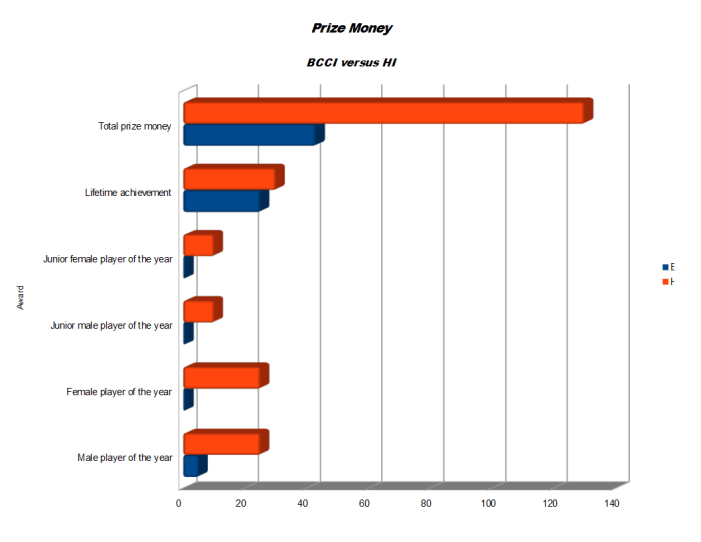
Prize Money: BCCI versus HI
Hockey India are more generous employers than their cricketing counterparts—the BCCI.
Would you believe that?
It’s true.
India’s national game body gives away Rs. 1.30 crores in prize money every year, while the BCCI doles out a measly Rs. 43 lakhs.
Don’t bolt for the astro-turf fields yet.
This doesn’t account for the moolah in the IPL and that cricketers are the highest paid (sporting) endorsers of Indian goods and services.
Other games have a long way to go. But they may be getting there.
Will this be Mahi’s last World T20?
India take on Australia in a virtual quarter-final this evening at Mohali.
The other three semi-final places have already been booked.
West Indies, New Zealand and England are through to the business end of the World T20.
India are favourites having thrashed the Kangaroos 3-0 Down Under but not before losing the ODI series 1-4.
No team has won the World T20 more than once.
Every edition has been unpredictable.
India, Pakistan, England, West Indies and Sri Lanka have all been crowned victors in this topsy-turvy format.
With no time for recovery from any mistakes, the team which turns up wins.
A stellar performance with the bat or ball is more than enough to decide a game.
If past trends hold, we ought to have a new champion.
Should Australia win tonight and the trend continue, it could be either New Zealand or Australia lifting the trophy, with the prospect of a mouth-watering repeat of last year’s ODI World Cup final.
Indian fans will be disappointed though.
This is probably MS Dhoni’s last T20 World Cup.
Dhoni does not see himself participating in the 2019 ODI World Cup.
Don’t be surprised if Mahi pulls out yet another rabbit from his hat and calls it a day—win or lose.

Mahendra Singh Dhoni bowlingat Adelaide Oval (Photo credit: Wikipedia)
Ravichandran Ashwin: What he said, really meant and definitely didn’t
Ravichandran Ashwin’s cheeky advice is not tested.
What he said:
“I probably gave him a cheeky idea to try a mankad in the end. We might have taken flak, but why not.”
India’s Ravichandran Ashwin claims that he wasn’t averse to his teammate Hardik Pandya running out his Bangladeshi opponents in the final over of the crucial group encounter played at Bengaluru last evening.
The controversial method of getting batsmen out has been in the news ever since West Indian Keemo Paul mankaded a Zimbabwean player in the recent Under-19 ODI World Cup.
Pandya didn’t have to resort to such an eventuality; his skipper ran out Mustafizur Rahman at his end to clinch the game for India by one run.
What he really meant:
“The Mankad’s not illegal and a win is a win by any legal means.”
What he definitely didn’t:
“Hardik Pandya and I wouldn’t take a running start at the bowler’s end were my team in the same situation.”
Gautam Gambhir: What he said, really meant and definitely didn’t
Gautam Gambhir is quite tone-deaf when it comes to Bachchan.

Gautam Gambhir at Adelaide Oval (Photo credit: Wikipedia)
What he said:
“I am nothing more than a mere mortal when it comes to judging Bachchan, even if he was cooking an omelette.”
Former India cricketer and opener Gautam Gambhir professes his unreserved admiration for the great Hindi film thespian Amitabh Bachchan. The baritone-voiced actor sang the Indian national anthem prior to the Indo-Pak World T20 encounter last evening at Eden Gardens in Kolkatta.

Amitabh Bachchan photographed by Studio Harcourt Paris Français : Amitabh Bachchan photographié par Studio Harcourt Paris Harcourt Paris (Photo credit: Wikipedia)
Gambhir added:
“Here he was, at my beloved Eden Gardens, his deep voice in its full youth, loaded with grace and admiration for the national anthem. Only soldiers can sing better that Bachchan did on Saturday.”
What he really meant:
“I’m a huge fan of Hindi film cinema and Amitabh Bachchan in particular. In my eyes, he can do no wrong. He could even boil water and I’d watch with open-mouthed admiration.”
What he definitely didn’t:
“I wonder how Shah Rukh Khan would have sung the anthem instead. Perhaps, a duet with Kajol would have baked an Eden cake.”
Hardik Pandya: Bravery and pressure
“Twenty20 is quite an interesting format. In the end, you have to be brave. Pressure does not give you anything, it only gives you blood pressure.”
—Hardik Pandya.
Eoin Morgan: Little bit of naivete
“Having a little bit of naivete with a huge amount of talent isn’t a bad thing.”
—Eoin Morgan.
Go Sports Foundation’s Handbook for young Indian athletes is a must go-to
In one of my posts on the Lodha Commission recommendations to the BCCI, a reference was made to Go Sports Foundation’s handbook for young Indian athletes and how a similar publication could be off immense help to aspiring cricketers.
Go Sports Foundation is a non-profit trust established in September 2008.
Their mission is to empower India’s future Olympians.
Their board of advisors consists of Abhinav Bindra, Rahul Dravid and Pullela Gopichand.
Their programmes are broken up into two kinds:
- Athlete Development Programmes that include Rahul Dravid Athlete Mentorship Programme,Badminton Development Programme, Para-Champions Programme, Abhinav Bindra Shooting Development Programme and Athletes’ Education Programme.
- Ecosystem Projects such as Athletes’ Conclave and Beyond the Finish Line.
The Athletes Handbook 2013: FAQs for the Young Indian Athlete is co-authored by some of the top names connected to Indian sport.
Bhishmaraj Purushottam Bam, a sports psychologist, a former Inspector General of police and qualified coach in pistol and rifle shooting answers questions pertaining to Mental Conditioning.
Sharda Ugra, a sportswriter and currently with ESPN Cricinfo, advises the young athlete how to interact with the media.
Deckline Leitao, a Sports Performance Specialist, replies to question on Fitness Training.
Dr. Korulamani Santosh Jacob, an orthopaedic surgeon specialising in arthroscopy and sports medicine and once team doctor to the Indian men’s hockey side, is all about Sports Medicine.
Nandan Kamath, a boutique sports and intellectual property lawyer and a graduate of Harvard Law School, the University of Oxford (on a Rhodes scholarship) and
the National Law School of India talks about legal and commercial issues. He’s also a former junior cricketer and Managing Trustee of the Go Sports Foundation.
Finally, Ryan Fernando, a certified Performance Nutrition Expert, dwells on Sports Nutrition in the final section.
The booklet’s foreword states:
“Professional help is not always easily accessible to the community of aspiring athletes. This Handbook of FAQs is an attempt to start bridging that gap.”
Some gems from this guide are as follows:
Bhishmaraj Purushottam Bam:
“Dwelling on past mistakes builds a wrong response and the errors creep into your system. This damages your confidence. Focusing on the result of the match makes it difficult for you to handle the challenges at hand well.”
“You need not waste unnecessary efforts in staying focused before the competition. It is your focus during the competition that matters. The pressure that builds up before the match, causing butterflies in your stomach, is actually a good thing as it indicates your keen interest to perform well. Do not link it with failure. Tell yourself that you are going to do very well since you are getting the jitters. Not feeling the pressure before a match is a bad sign, as it could mean that you are either bored with your game or are underestimating your opponents.”
“…form is very elusive and fickle. It can come in one match and disappear in the other. Learn to take every match very seriously. As the saying goes, ‘The better player does not win; the player who plays better wins’. It is your responsibility to play better.”
“If you have lost to a particular player a number of times previously, that is all the more reason for you to play better than him/her and win. Do not take others’ (or even your own) game for granted. Just keep trying to win the point being played and keep your focus on the ball or the shuttle. Look for a chance to meet that player again and again for playing him/her is a test of your mental toughness. Visualise your correct movements and not the mistakes made in the previous matches.”
“Do not be afraid of negative thoughts or doubts. They can cause damage to you only if you focus on them. Keep some positive thoughts ready for introduction and focus on them. If these thoughts are coming from your own positive experience they help a lot. Write a diary of excellence and enter in it only your positive experiences. This will help you build up a positive self-talk for occasions when the negative thoughts attack you.”
Sharda Ugra:
“What the outside world particularly also likes, which you must not forget, is humility. Talking down someone or something else may sound ‘confident’ but as you hope you will have a long career, remember there will come a time when someone may talk your hard work down in the same tone and you will not like it. You don’t need to be awed by your competitors but neither must you look down on them. Be respectful. At least in the media!”
“The first step to gauging trust is to see if the journalist passes the OTR (Off the Record) test: If in the course of a conversation you let slip a comment that you do not want quoted with your name in it, and say, ‘This is off the record.’ If the journalist uses it in their article quoting you and offers an apology like, ‘I was forced to’, ‘my boss demanded it’, or, ‘it was inserted by someone else’, it is necessary to be a little wary in the course of future conversations with them.”
“How do I avoid answering a question that I am not comfortable answering?
Ans: Say exactly – and always with a smile – any of the following:
’That’s not something I want to talk about.’ ‘That’s something I would rather not speak about.’
’I have no comment to make about that.’
’I have nothing to offer on that subject, thanks.’
If they ask the same question over and over again, you should say, ‘I’ve already
indicated that this is something I am not going to be talking about, so let’s move on.’”
“Ideally the media should pursue you, not the other way around and that happens through performance.”
Deckline Leitao:
“One should never go completely off fitness training even in the off season. It is always good to maintain 50% fitness during this period as it will help you get back in shape more quickly when the competitive season starts.”
“Remember the saying – Anybody can train when he/she feels like doing it, but a champion trains even when he/she doesn’t feel like doing it!”
Dr. Santosh Jacob:
“The primary role of the physiotherapist is to prevent injuries, and he/she should be able to identify problems in posture/technique and remedy them before a serious injury is sustained. When an athlete is injured, the physiotherapist plays a key role in aiding rehabilitation, helping the athlete regain peak fitness and return to the competitive arena at the earliest; and also prevent re-injury.”
“P.R.I.C.E.S. is the acronym for best practice in first aid that is internationally accepted. It stands for:
Prevention
Rest
Ice
Compression
Elevation
Splinting (to provide an external support to an injured portion of the body usually by the use of a brace or a well wrapped bandage strapping. The aim is to immobilize, to reduce pain caused by movement or muscle contraction).”“A healthy athlete should be able to recover completely from donating blood in eight weeks, but he/she may lose some of the ability to train for the first few days.
Following a donation of one pint, blood volume is reduced by about ten percent and returns to normal in 48 hours. For two days after donating, you should drink lots of fluids and probably exercise at a reduced intensity or not at all. There is a definite reduction in peak (maximal) performance but it does not appear to affect training (submaximal) performance after 48 hours. So, the take home message is: if you are an endurance athlete or are about to enter an elite competition, do not donate blood. However, if it is off-season or an event is not lined up for roughly 3 months, it should be perfectly safe to do your social duty.”
Nandan Kamath:
“Early on in your career, you will be tempted to take every commercial offer that you receive. This approach may not always be in your long term commercial interest. At the beginning of a career, it is best to focus on a small number of high quality sponsorships and endorsements. These do not come knocking often and one must often wait with some patience for them. The ability to refuse the wrong relationships early on increases your long term brand value and makes you far more attractive once you are an established international athlete.”
“…contracts are not “take it or leave it”. A contract presented to you by someone else will be drafted in a manner most favourable to that person and the first draft offered to you should act as a starting point and not the last and final offer. There is (almost) always room to negotiate the terms and conditions of such a contract and it is very important that you make sure all of your interests are protected and documented in the contract. It is customary to provide your comments and feedback on a contract and to attempt to have the contract reflect the positions you want through a negotiation process. A failure to negotiate means that you are likely to leave a lot on the table and lose out value that you might have otherwise been offered were you just willing to ask. An athlete who is aware of his/her rights and is willing to stand up for his/her own interests is always likely to be taken more seriously and, in the long run, will always get a better deal.”
Ryan Fernando:
“If the duration of the activity for an individual athlete is fairly continuous for 1 hour or longer, a sports drink is the better replacement fluid. However, if the activity lasts less than 1 hour, water is the best option. In either case, an athlete should have about 6-8 ounces of fluid replacement every 30 minutes during strenuous, continuous activity.”
“Unless a particular athlete has an allergy to milk or is lactose intolerant, there is no reason to avoid 1% or skim milk. These are an excellent source of both carbohydrate and protein with very little or no fat. Having 250 ml of skim or 1% milk or yogurt up to 2 hours before a competitive event can even help boost blood sugar (forms of carbohydrate) for the early minutes of the competition. The protein will kick in with additional fuel a little later.”
Sanjay Manjrekar: Popularity and talent
“To produce extraordinary talent, the most important requirement is for that sport to be popular in the country. For popularity breeds competition; and where there is competition, only exceptional talent will come to the fore.”
—Sanjay Manjrekar.
BMC’s open spaces policy is controversial—to say the least
The Brihanmumbai Municipal Corporation (BMC) has recovered 34 of 36 open spaces by January 28 on the basis of a notice issued on the 18th of that month.
But the battle for Mumbai’s green lungs is far from over.
Maharashtra chief minister Devendra Fadnavis had ordered the taking back of 200-plus open spaces—maintained by private organizations. He also asked that the new open spaces policy be reviewed.
The BMC intends to outsource maintenance of these playgrounds and recreation areas to private organizations and corporate entities.
This has been opposed by activists who believe that it is the BMC’s responsibility to support these open spaces. They are of the opinion that parcelling out upkeep of these facilities leaves the door open to misuse of these open spaces as in the past when they were used to generate income via commercial activities.
The municipal body, however, claims that maintaining open spaces is not an obligatory function.
The BMC’s new open spaces bill tabled and passed in its assembly hopes to improve on the previous caretaker policy.
Seema Kamdar of First Post writes:
“After all, as the corporation says, taking care of the open spaces does not fall under its obligatory roster. Rather, it’s a discretionary activity, and clearly not important. All that it expects from its lessees for such spaces – also called RGPG for recreation grounds, gardens, parks and playgrounds – is a perimeter fence, a security guard and a toilet; the rest was up to its imagination.”
On the caretaker policy, Kamdar writes:
“The caretaker policy, developed in 1991, permitted construction on 15 percent of the area, such as club, gymnasia, etc. The history of the adoption and caretaker policy of Mumbai of public open spaces is criss-crossed with stories of rampant misuse, illegal construction, controlling public access or restricting their hours of free access, exploitation for commercial benefit, neglect of maintenance, poor or no security leading to encroachment and such brazen flouting of the rules.”
Sayli Udas-Mankikar writing for DNA India terms the new policy ‘draconian’.
She says:
“A draconian policy, it puts out over 1068 spaces, including parks, playgrounds and gardens spanning over 1200 acres, roughly the size of 588 international football pitches, up for adoption. Some of these are sadly fated to become ‘clubs’ under a special clause.”
She adds:
“There is no explanation to why the BMC, the richest corporation in the country, which has set aside Rs200-crore for maintaining open spaces — calculations show it comes to Rs36 lakh per plot — cannot maintain these little patches of green.
What is disheartening is the cavalier attitude of public representatives, who will be knocking on our doors for votes during the 2017 BMC elections exactly a year later. The Shiv Sena, which is putting up a fight to open up the Mahalaxmi race course as a public park, has been at the forefront of clearing this policy. The BJP sold a pup to the citizens by first agreeing to rework the policy, and then did a volte face to back the Sena. The opposition merely took to photo-ops a day later as a mark of protest.
The BMC gives feeble arguments to justify the policy. Without any defined objective, it favours private entities to qualify as adopters over the more desirable local community organisations. The selection committee itself has no citizen-representative or an expert to veto the administrative proposals. Issues like greening missions, sport, women’s safety, heritage, local culture and multi-use of spaces do not even find a mention. This does not behove a city with global aspirations.”
The new open spaces policy envisages placing the caretaker bodies under the Right To Information (RTI) act thus making them accountable to the general public.
Right to Information (RTI) expert Shailesh Gandhi said, “This is not an open space policy, but kidnapping policy.”
Shailesh Gaekwad writes for Hindustan Times:
“It would make more sense for the citizen groups to now demand that the maintenance of open spaces be included among the obligatory duties of the BMC and of course a policy which favours the citizens, not politicians and moneybags.”
Number of readers subscribed
Read it on Apple News

Read it on Apple News
Stat Counter
 Sports, Health and Exercise
- An error has occurred; the feed is probably down. Try again later.
 Make Time For Sports.