Make Time For Sports.
News
Higher prize money on offer by Hockey India does not tell the full story
| Prize Money: BCCI versus HI | ||
| Award (in lakhs) | BCCI | HI |
| Male player of the year | 5 | 25 |
| Female player of the year | 0.5 | 25 |
| Junior male player of the year | 0.5 | 10 |
| Junior female player of the year | 0.5 | 10 |
| Lifetime achievement | 25 | 30 |
| Total prize money | 43 | 130 |
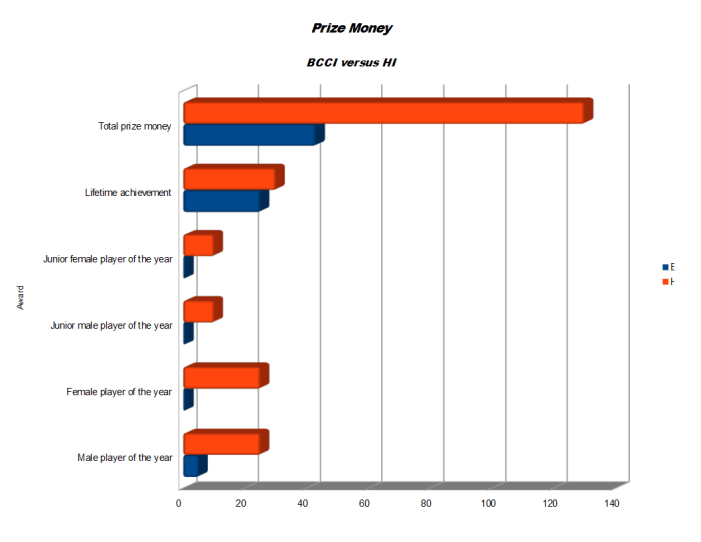
Prize Money: BCCI versus HI
Hockey India are more generous employers than their cricketing counterparts—the BCCI.
Would you believe that?
It’s true.
India’s national game body gives away Rs. 1.30 crores in prize money every year, while the BCCI doles out a measly Rs. 43 lakhs.
Don’t bolt for the astro-turf fields yet.
This doesn’t account for the moolah in the IPL and that cricketers are the highest paid (sporting) endorsers of Indian goods and services.
Other games have a long way to go. But they may be getting there.
Will this be Mahi’s last World T20?
India take on Australia in a virtual quarter-final this evening at Mohali.
The other three semi-final places have already been booked.
West Indies, New Zealand and England are through to the business end of the World T20.
India are favourites having thrashed the Kangaroos 3-0 Down Under but not before losing the ODI series 1-4.
No team has won the World T20 more than once.
Every edition has been unpredictable.
India, Pakistan, England, West Indies and Sri Lanka have all been crowned victors in this topsy-turvy format.
With no time for recovery from any mistakes, the team which turns up wins.
A stellar performance with the bat or ball is more than enough to decide a game.
If past trends hold, we ought to have a new champion.
Should Australia win tonight and the trend continue, it could be either New Zealand or Australia lifting the trophy, with the prospect of a mouth-watering repeat of last year’s ODI World Cup final.
Indian fans will be disappointed though.
This is probably MS Dhoni’s last T20 World Cup.
Dhoni does not see himself participating in the 2019 ODI World Cup.
Don’t be surprised if Mahi pulls out yet another rabbit from his hat and calls it a day—win or lose.

Mahendra Singh Dhoni bowlingat Adelaide Oval (Photo credit: Wikipedia)
Johann Cryuff: Extraordinary quotes from an extraordinary player
Johann Cryuff passed away yesterday—aged 68—of lung cancer.
One of the pioneers of Total Football, the Dutchman was part of the side that played the 1974 World Cup final.
The Netherlands were unfortunately edged out by Franz Beckenbaeur’s West Germany.
They reached the finals once again in 1978—without Cryuff—losing out to Argentina.
Holland made the finals only one more time—in 2010—succumbing to Spain.
Here are some astounding quotes from Cryuff—Player, Philosopher, Manager:
On technique:
“Technique is not being able to juggle a ball 1000 times. Anyone can do that by practicing. Then you can work in the circus. Technique is passing the ball with one touch, with the right speed, at the right foot of your team mate.”
“Someone who has juggled the ball in the air during a game, after which four defenders of the opponent get the time to run back, that’s the player people think is great. I say he has to go to a circus.”
On teamwork:
“Choose the best player for every position, and you’ll end up not with a strong XI, but with 11 strong 1’s.”
“In my teams, the goalie is the first attacker, and the striker the first defender.”
On rich clubs:
“Why couldn’t you beat a richer club? I’ve never seen a bag of money score a goal.”
On leadership:
“Players that aren’t true leaders but try to be, always bash other players after a mistake. True leaders on the pitch already assume others will make mistakes.”
On speed and timing:
“What is speed? The sports press often confuses speed with insight. See, if I start running slightly earlier than someone else, I seem faster.”
“There’s only one moment in which you can arrive in time. If you’re not there, you’re either too early or too late.”
“When you play a match, it is statistically proven that players actually have the ball 3 minutes on average … So, the most important thing is: what do you do during those 87 minutes when you do not have the ball. That is what determines whether you’re a good player or not.”
On mistakes:
“Before I make a mistake, I don’t make that mistake.”
On winning:
“After you’ve won something, you’re no longer 100 percent, but 90 percent. It’s like a bottle of carbonated water where the cap is removed for a short while. Afterwards there’s a little less gas inside.”
“If you can’t win, make sure you don’t lose.”
On team tactics:
“We must make sure their worst players get the ball the most. You’ll get it back in no time.”
“If you have the ball you must make the field as big as possible, and if you don’t have the ball you must make it as small as possible.”
“There are very few players who know what to do when they’re not marked. So sometimes you tell a player: that attacker is very good, but don’t mark him.”
“Every disadvantage has its advantage.”
“There is only one ball, so you need to have it.”
On tough first rounds:
“Surviving the first round is never my aim. Ideally, I’d be in one group with Brazil, Argentina and Germany. Then I’d have lost two rivals after the first round. That’s how I think. Idealistic.”
On results, quality and integrity:
“Quality without results is pointless. Results without quality is boring.”
“People who are not of my level can’t affect my integrity.”
On using computers:
“I find it terrible when talents are rejected based on computer stats. Based on the criteria at Ajax now I would have been rejected. When I was 15, I couldn’t kick a ball 15 meters with my left and maybe 20 with my right. My qualities technique and vision, are not detectable by a computer.”
On keeping it simple:
“Playing football is very simple, but playing simple football is the hardest thing there is.”
On being understood:
“If I wanted you to understand it, I would have explained it better.”
Finally:
“In a way I’m probably immortal.”
Ravichandran Ashwin: What he said, really meant and definitely didn’t
Ravichandran Ashwin’s cheeky advice is not tested.
What he said:
“I probably gave him a cheeky idea to try a mankad in the end. We might have taken flak, but why not.”
India’s Ravichandran Ashwin claims that he wasn’t averse to his teammate Hardik Pandya running out his Bangladeshi opponents in the final over of the crucial group encounter played at Bengaluru last evening.
The controversial method of getting batsmen out has been in the news ever since West Indian Keemo Paul mankaded a Zimbabwean player in the recent Under-19 ODI World Cup.
Pandya didn’t have to resort to such an eventuality; his skipper ran out Mustafizur Rahman at his end to clinch the game for India by one run.
What he really meant:
“The Mankad’s not illegal and a win is a win by any legal means.”
What he definitely didn’t:
“Hardik Pandya and I wouldn’t take a running start at the bowler’s end were my team in the same situation.”
Raymond Moore hits all the wrong buttons at Indian Wells
In 2014, it was Shamil Tarpsichev, the President of the Russian Tennis Federation , who set the blogosphere afire with his ill-advised comments about the Williams’ gender on national television.
This time, it’s Raymond Moore, the Indian Wells tournament director who put his foot into his mouth when he remarked thus:
“In my next life when I come back I want to be someone in the WTA, because they ride on the coat tails of the men. They don’t make any decisions and they are lucky. They are very, very lucky. If I was a lady player, I’d go down every night on my knees and thank God that Roger Federer and Rafa Nadal were born, because they have carried this sport. They really have.”
The South African is a former tennis player and helped establish the joint ATP-WTA tourney.
Moore compounded his folly further by speculating on the future of women’s tennis without Maria Sharapova.
He named Garbine Muguraza and Genie Bouchard as being both “physically attractive and competitively attractive” and that they “can assume the mantle of leadership once Serena decides to stop.”
Moore later apologised but not before a flurry of rejoinders and calls for his resignation from players, commentators and fans alike.
While these are the sort of comments that one can expect from arm-chair fans and critics of the game in the comfort of their homes , or even spectators in sports bars after the influence of a few drinks in rowdy company, it’s not becoming from the CEO of the tournament. He risks alienating women players and their fans.
Serena Williams responded:
“I don’t think any woman should be down on their knees thanking anybody like that. I think Venus, myself, a number of players — if I could tell you every day how many people say they don’t watch tennis unless they’re watching myself or my sister — I couldn’t even bring up that number. So I don’t think that is a very accurate statement.
I think there is a lot of women out there who are very exciting to watch. I think there are a lot of men out there who are exciting to watch. I think it definitely goes both ways.
There’s only one way to interpret that. ‘Get on your knees,’ which is offensive enough, and ‘thank a man’? We, as women, have come a long way. We shouldn’t have to drop to our knees at any point.”
Patrick McEnroe was among those calling for Moore’s sacking.
Novak Djokovic, however, was his incorrigible self.
He said:
“I think that our men’s tennis world, ATP world, should fight for more because the stats are showing that we have much more spectators on the men’s tennis matches. I think that’s one of the, you know, reasons why maybe we should get awarded more.
Women should fight for what they think they deserve and we should fight for what we think we deserve. I think as long as it’s like that and there is data and stats available and information, upon who attracts more attention, spectators, who sells more tickets and stuff like that, in relation to that it has to be fairly distributed.
Knowing what they have to go through with their bodies — and their bodies are much different than men’s bodies — they have to go through a lot of different things that we don’t have to go through. You know, the hormones and different stuff — we don’t need to go into details. Ladies know what I’m talking about. Really, great admiration and respect for them to be able to fight on such a high level.”
Moore may have apologised and the brouhaha over his remarks will probably die down in a week or so. The average fan’s memory is short-lived.
The gender divide persists.
There exists parity in earnings between men and women at the Grand Slams and other joint tournaments like Indian Wells. Scoffers and skeptics may enquire whether women shouldn’t play five sets as well at the Slams.
Also, shouldn’t, as Djokovic points out, there be attempts to make the women’s game more interesting to the spectators? How many fans can testify to finding women’s matches as evenly matched as men’s?
Also, at the risk of sounding sexist, why shouldn’t the attractiveness of women players be a reason for drawing fans in? The modern men’s game has no real personalities.
Without one of the Big Four—Federer, Nadal, Djokovic or Murray, it’s relatively difficult to market a tourney to fans.
Is there no shred of truth in Moore’s remarks , misogynistic as they seem?
The Program: Lance Armstrong does not live strong
Rating: 2.5 stars out of 5 stars.
Cast: Ben Foster as Lance Armstrong, Chris O’Dowd as David Walsh, Guillaume Canet as Michele Ferrari, Jesse Plemons as Floyd Landis, Lee Pace as Bill Stapleton, Denis Menochet as Johan Bruyneel, Dustin Hoffman as Bob Hamman, Edward Hogg as Frankie Andreu,Elaine Cassidy as Betsy Andreu,Laura Donnelly as Emma O’Reilly, Bryan Greenberg, Sam Hoare as Stephen Swart, Kevin Hulsmans as Filippo Simeoni, Alex Croft as Unspecified European Cyclist, Matthew Radford as Unspecified Mountain Bike Rider, Josh O’Connor as Rich, Nathan Wiley as Charles Pelkey.
The Program is a film based on journalist David Walsh’s book Seven Deadly Sins: My Pursuit of Lance Armstrong.
Walsh of the Sunday Times is convinced that Lance Armstrong’s victories in the Tour De France are fueled by performance-enhancing drugs. The journalist’s reaction on meeting Armstrong for the first time is that he’s good but not great.
“He’s good enough to win a day race but not the Tour,” he announces to his fellow journalists but then Armstrong has him eating his words.
Armstrong too realises that he’s just not good enough to win the Tour De France on his own. He turns to Italian physician Michele Ferrari for help.
Ferrari rejects him initially because he believes that Armstrong is simply not built for racing.
Armstrong is struck with testicular cancer but recovers to found the Live Strong foundation to assist other cancer survivors.
But the film leaves the viewers with no ambiguity about Armstrong’s villainy when a doctor bursts into his hospital room with the query whether he had ever used performance enhancing drugs while training.
Following his recovery, Armstrong seeks out Ferrari again this time convincing him that his body shape has changed since his cancer treatment.
Ferrari agrees to work with him starting him on a course of Erythropoietin or EPO. EPO increases the production of red blood cells thus increasing VO2 max in athletes.
Armstrong is the leader of the US Postal Team winning the Tour De France seven consecutive times. Armstrong institutes a doping culture within the side that includes Floyd Landis who is seen as the logical successor to Armstrong when he retires.
Armstrong considers himself bigger than the sport itself believing himself to be untouchable; he feels that the integrity of cycling would be compromised if his positive test results are disclosed to the world at large.
Armstrong manages to appear above it all; challenging his opponents in court and in the court of public opinion claiming that he has never tested positive.
He takes Walsh and the Sunday Times to court and wins damages.
Armstrong also wins a case against SCA Promotions who attempt to withhold his $5 million bonus.
The Texan retires after claiming a record seven Tour De France titles. He is widely considered the greatest ever cyclist.

Lance Armstrong at the team presentation of the 2010 Tour de France in Rotterdam (Photo credit: Wikipedia)
Following his retirement, his former teammate Floyd Landis wins the 2006 Tour De France. He later tested positive for an unusually high ratio of the hormone testosterone to the hormone epitestosterone (T/E ratio).

Landis at the 2006 Tour of California (Photo credit: Wikipedia)
Landis first denied the allegations but later testified to the same accusing Armstrong among others.
The Federal investigation leading from his allegations was dropped but a later United States Anti-Doping Agency (USADA) investigation found Armstrong guilty. He was banned for life.
With his lies unraveling, Armstrong finally comes clean to Oprah Winfrey on national television.
Ben Foster plays Armstrong with a conviction that conveys his single-mindedness in pursuit of cycling’s Holy Grail. He brooks no opposition in pursuit of his goal. He can be both charming and charismatic. He rubs shoulders with the high and mighty and the best of Hollywood. He has no qualms about cheating believing that the sport is riddled with them.
Jesse Plemons is Floyd Landis, a conflicted rider who sees Lance as his mentor but is devastated on being left out in the cold when he’s caught. He gives up Armstrong and his former teammates turning whistle-blower.
The movie though leaves you cold. Armstrong has no redeeming qualities–even his work for his own foundation Live Strong leaves the audience unmoved.
Catch it if you’re interested in the Armstrong saga. But don’t expect fireworks or thrilling sporting action. There is very little to redeem a movie that could well have been a documentary.
Race: Jesse Owens, racism and Nazism
Rating: 3 stars out of 5.
Directed by Stephen Hopkins
Cast: Stephan James as Jesse Owens, Jason Sudeikis as Larry Snyder, Shanice Banton as Ruth Solomon-Owens, Jeremy Irons as Avery Brundage, William Hurt as Jeremiah Mahoney, Carice van Houten as Leni Riefenstahl, Amanda Crew as Peggy, Jeremy Ferdman as Marty Glickman, Barnaby Metschurat as Joseph Goebbels, David Kross as Carl “Luz” Long, Glynn Turman as Harry Davis, Jonathan Aris as Arthur Lill, Shamier Anderson as Eulace Peacock, Tony Curran as Lawson Robertson, Nicholas Woodeson as Fred Rubien, Giacomo Gianniotti as Sam Stoller, Eli Goree as Dave Albritton, Anthony Sherwood as Rev. Ernest Hall, Jon McLaren as Trent, Tim McInnerny as General Charles, Vlasta Vrána as St. John, Adrian Zwicker as Adolf Hitler.
Race is a movie about Olympic races and racism. Set in the 1930s when segregation existed in the United States, it recounts Jesse Owens’ journey towards becoming arguably the greatest athlete of the 20th century.
The biopic begins with young Jesse being accepted to Ohio State University. Coach Larry Snyder’s goal is to ensure his qualification to the 1936 Berlin Olympics.

Jesse Owens (Photo credit: Wikipedia)
Snyder initially comes across as someone who sees Jesse as an ends to relive his own shattered dreams of Olympic glory. His character warms up helping Jesse with a stipend to send home to his girlfriend Ruth and baby daughter. Snyder advises Jesse when he suffers heartbreak at his dilemma about whether he should continue with his new love interest—city girl Peggy— or try and win back his childhood sweetheart, Ruth.
Snyder is the unwitting witness to the continuation of the cleansing policy against Jews instituted by the German dictator when he visits Berlin downtown to pick up shoes made by Adi Dasler, the founder of Adidas. Owens thus becomes the first African-American endorser for a shoe company.
Training at the Ohio State University, Jesse learns to stay crouched and bent into an explosive start to reduce wind resistance. This is enforced by the use of hurdles that he would dash into if he were upright too soon into his stride. Jesse and his fellow runners are taught how smaller strides don’t necessarily mean that they’re moving slow as long as their leg turnover is substantially higher than normal.
Jesse (actually pronounced Jay Cee) is no paragon of virtue, although a speed demon on the track. He is a young man who succumbs to temptation and bright lights when away from his girlfriend Ruth. He realizes his folly and asks Ruth to marry him which she does. Ruth, however, is no shrinking violet, sending her beau a breach of promise notice on learning of his dalliance with Peggy.
Avery Brundage makes the case for American athletes participating at the Berlin Games. His proposition is passed by a narrow margin by the US Olympic Committee. The reigning president of the Amateur Athletic Union, Jeremiah T Mahoney, resigns in protest. His conscience wouldn’t allow him to support American participation in the Games.
Jesse is forced to make a choice. Should he run at the Berlin Games and be perceived as supporting Hitler’s policies towards Jews and Negroes or stay home and forgo his chance for glory?
There follows a telling scene where Jesse has a showdown with Snyder about the issue. Snyder snaps at Jesse saying that he doesn’t care what the African – Americans have to say about his participation in the Games; both Jesse and he have worked too hard to just throw it away. Jesse responds that he doesn’t have to because African-Americans aren’t his people.
Jesse finally decides to take part; his teammate Eulace Peacock who suffers a hamstring pull before the Games convinces him that participating is the best way to prove that Hitler is wrong— no one would remember him as the athlete who walked away. He’d certainly be recalled as the Olympian who won gold at Hitler’s games.
On arriving in Berlin, Germany, Jesse and his African-American teammates are surprised that the athletes’ mess and rooms at the Games are not segregated.
Owens—wearing a jersey numbered 733—wins the 100 metres quite easily. He is, however, snubbed by Adolf Hitler who leaves the stadium without shaking his hand. Olympic Committee officials had insisted that the Fuhrer personally greet every victor. The dictator chooses instead to wish German athletes only.
(Though not depicted in the biopic, Owens said at the time:
“Hitler had a certain time to come to the stadium and a certain time to leave. It happened he had to leave before the victory ceremony after the 100 meters. But before he left I was on my way to a broadcast and passed near his box. He waved at me and I waved back. I think it was bad taste to criticize the ‘man of the hour’ in another country.”
Owens would later say:
“Some people say Hitler snubbed me. But I tell you, Hitler did not snub me. I am not knocking the President. Remember, I am not a politician, but remember that the President did not send me a message of congratulations because people said, he was too busy.”
And later:
“Hitler didn’t snub me – it was our president who snubbed me. The president didn’t even send me a telegram.”
)
Luz Long, Jesse’s rival in the broad jump, is an epitome of sportsmanship. He helps Jesse qualify by placing a towel before the takeoff line. His portrayal reminds us that not all Germans acquiesced to Hitler’s policy against the Jews and his notions of Aryan supremacy. Luz discloses to Owens—post the broad jump event—that he refused the company of a young woman sent to his room to entertain him during the games suspecting that her only wish was to impregnate herself with a specimen of Teutonic manhood. Luz lost his life during the Second World War. (Being sent to the warfront was usually a punishment posting for Germans opposed to the Nazi regime.)
Jesse wins the broad jump final quite handily. He follows suit in the 200 metres.
It’s not entirely a victory for American ideals against Nazi ideology . Jesse’s Jewish teammates, Marty Glickman and Sam Stollerare, are cut from the 4*100 relay, a concession made to Goebbel on behalf of the Fuhrer.
Owens returns home a triumphant American hero only to take the service elevator to his own felicitation dinner.
An interesting sidelight in the movie is the depiction of Leni Riefenstahl, the German film director, producer, screenwriter, editor, photographer, actress, dancer, and propagandist for the Nazis. Riefenstahl is invited by Joseph Goebbels, Minister of Propaganda, to film the Games. Her film Olympia was highly successful and included shots of all competitors. Reifenstahl—in the movie—ignores Goebbels to film the famous montage of Owens.

Carl Lewis would go on to emulate Owens at the 1984 Los Angeles Olympics , a games hit by a retaliatory boycott by the Soviets for the 1980 shunning by the Americans.
Owens—-unsuccessfully— tried to convince then President Jimmy Carter against it because he felt that the Olympic ideal was a time-out from war and above politics.
Owens remained married to Ruth until his death in 1980 of lung cancer. He was a chain smoker for 35 years.
Hardik Pandya: Bravery and pressure
“Twenty20 is quite an interesting format. In the end, you have to be brave. Pressure does not give you anything, it only gives you blood pressure.”
—Hardik Pandya.
Martin Crowe—an obituary
I never watched Martin Crowe bat.
At least, I don’t think I did. If I did, I can’t recall much anymore. Perhaps, clips of his batting are available on YouTube to refresh my memory.
Remember these were the days before satellite television and the matches telecast were mostly India games or the World Cup.

Russell and Martin Crowe (Photo credit: Wikipedia)
Martin Crowe, however, will go down as New Zealand’s greatest batsman accompanied by Sir Richard Hadlee as their greatest all-rounder.
It was an era that saw a small cricketing nation punch much above its weight.
Besides his stellar batsmanship, Crowe is also remembered for his innovative ODI captaincy during the 1992 World Cup.
This was the Cup that saw a prodigal South Africa return to the fold. Jonty Rhodes’ fielding exploits and a heart-breaking exit in the semi-finals against England defined their World Cup campaign.
The Cup was Pakistan’s though; from almost being eliminated to clinching five games in a row to secure Imran Khan’s dream of a cancer hospital named for his mother.
New Zealand were co-hosts—much like last year’s World Cup where they went one better and made the final under Brendon McCullum’s stewardship.
Crowe made some dynamic changes to the game—opening the batting with a pinch-hitter, Mark Greatbatch. This set the stage for Sanath Jayasuriya and Kaluwitharna’s pairing in the 1996 World Cup co-hosted by India, Pakistan and Sri Lanka.
But it was his utilization of off-spinner Dipak Patel at the top of the bowling that paid rich dividends and had their opponents in a tizzy.
Martin Crowe continued to love his cricket, writing for CricInfo while battling his terminal disease. He also returned to the first-class game temporarily but his cancer relapsed.
The Kiwi great is no more. His funeral was held yesterday.
May his soul rest in peace.
God bless.
Eoin Morgan: Little bit of naivete
“Having a little bit of naivete with a huge amount of talent isn’t a bad thing.”
—Eoin Morgan.
Number of readers subscribed
Read it on Apple News

Read it on Apple News
Stat Counter
 Sports, Health and Exercise
- An error has occurred; the feed is probably down. Try again later.
 Make Time For Sports.