Make Time For Sports.
News
Leander Paes: Parents and champions
“Parents who wish to mould their kids into champions must recognise that the support system of the family is essential for an athlete’s success. Without your support, your child’s dreams will never grow wings.”
—Leander Paes.
Ashutosh Pednekar, racketlon and gold medals
You’re aware of decathlons, pentathlons and triathlons.
But what do you know of racketlon?
Racketlon is a combination sport where you play four racket sports in sequence from the lightest paddle to the heaviest: table tennis, badminton, squash and tennis.
A match consists of four sets running to 21 points in each sport. A two point margin is needed to secure a set.
Each player serves two points at a time from each side of the court—except in ping-pong.
The winner is the player who secures the most points—in total.
The Racketlon website elaborates on the more interesting aspects of the sport:
“The fact that in each individual sport a mediocre player can challenge a top player – on equal terms! The guy may even be on the world ranking in one of the sports – as long as the outcome of the overall match is unclear that set will still make up an interesting game! And this has significant implications for the tactical aspects of the game; It is one thing to play well against a player that is your equal but it is an entirely different matter to deliver a top performance against someone who is far below (or above) your own standard.
A second special characteristic of racketlon is the fact that all points count equal. In any of the individual sports, say tennis, you can afford loosing some points at some stages with no implications for the overall match whereas other points (e.g. set or match points) carry much more weight. A clear indication of this is that a tennis player may well win less points in total and still win the match. In racketlon all points are – to a much greater extent – equally important. Most racketlon players would agree that this has clear implications for how each of the games are played. ‘Racketlon badminton’, for example, seems like a whole different ball game compared to normal badminton not to mention ‘racketlon tennis’. If this is a pure psychological or, in additition, a mathematical consequence of the racketlon counting I leave open at the moment but it is beyond doubt, however, that a tennis gummiarm (Swedish for ‘rubber arm’ referring to the behaviour of the arm holding the racket at the time of ball impact) and accompanying ‘chicken’ play is a surprisingly common sight in racketlon contexts. In a tight match the concluding tennis event is often a matter of extremely tightly strung nerves. A lost point is a lost point and can never be compensated!”
India has a champion navy officer, Ashutosh Avinash Pednekar, who won medals in the over 45 and men’s amateur category at the Nordic Racket Games held at Vejen, Denmark on May 28 and 29 and at the Super World Tour – King of Rackets tournament held at Oudenaarde, Belgium from June 3 to 5.
He won gold at Denmark in both categories and gold and silver in Belgium.
The Commodore is looking forward to being the first Indian to win gold at the World Racketlon Championships scheduled later this year in November at Germany.
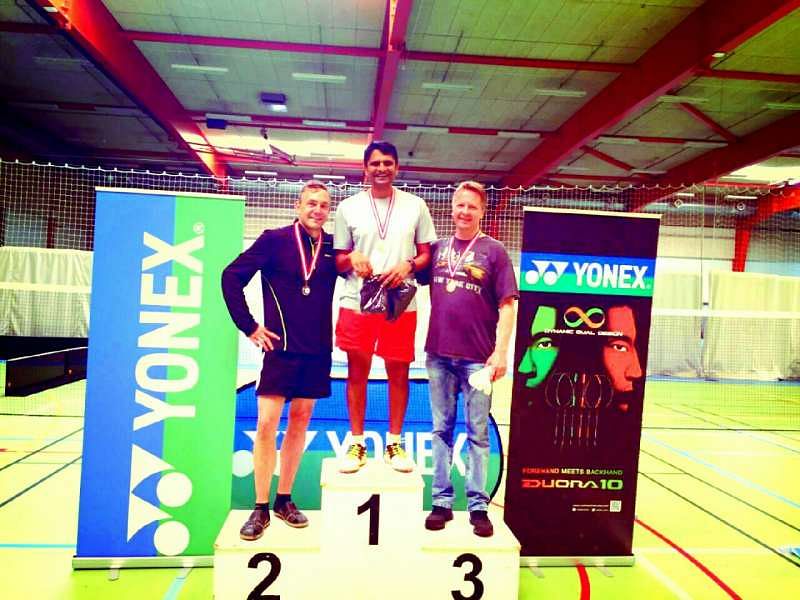
Pednekar was introduced to the sport by a fellow squash player Abhinav.
Speaking to SportsKeeda, he said:
“He gave me the interesting aspects of this sport and I got all the details through internet.I realised if I had to take part I need to have some strength in table tennis, a sport which was new to me. I gave myself six months to train hard and when I was confident I had touched reasonable level thought of my next step of participation.”
Ashutosh was already a keen squash and badminton player.
Can Ashutosh deliver on his promise of gold at the World Championships?
He replied:
“I have planned to sharpen my table tennis skills with a professional trainer and keep in good touch in the other three.”
Go well, Ashutosh, Lone Ranger of Indian Racketlon!
Lionel Messi retires from international soccer: Will he return?
What do you say to Lionel Messi when he loses yet another final and announces his retirement from internationals?
Are his fans to cry, “Come back, Messi, we’ll always love you, come what may”?
Or to join his plaintive chorus to ‘Don’t cry for me, Argentina’.
“Don’t cry for me Argentina
The truth is I never left you
All through my wild days
My mad existence
I kept my promise
Don’t keep your distance.”
Truth be told, my first reaction to Messi’s missed penalty was the demoralising effect it would have on his teammates. To see their skipper miss his shot by a mile could only create more flutters and nerves in their midst.
And sure enough, his teammates missed another and that was the end of Argentina’s Copa America Centenario dreams.
That Messi would take this loss to heart and view it as a personal failure could only be foreseen in hindsight.
Will Messi be back?
The magician with the ball does know that soccer is a team game and that he’s not expected to shoulder the blame for his team’s inadequacies. And it’s not as though there isn’t a blueprint available on how to nullify the Messi threat personified by an Argentinean side. Germany have done it before and Chile did it to them twice.
Messi is hardly the first high-profile player to miss a crucial penalty. His Real Madrid rival Cristiano Ronaldo missed one in this year’s Euro. Roberto Baggio and Michel Platini are on that unfortunate list too.
Time is a great healer and it’s possible that the lure of another World Cup could draw the mercurial forward back.
Yes, it’s possible, and we certainly hope to see him back in national colours.
Until then, we’ll continue to enjoy his exploits with Neymar and Luis Suarez for Barca.
Venus Williams: Fashion and function
“Fashion is very important for me, so (whatever I wear or design) always has to be fashionable. But clearly it also has to be functional. They go hand-in-hand. I wouldn’t pick one over the other. But it’s easy to design something functional without being fashionable. It’s about challenging yourself to push it a little bit.”
—Venus Williams.
Harvard Business School has a celebrity student—Maria Sharapova!
Maria Sharapova is full of surprises.
Just when her detractors and critics believed that she must be moping around waiting and hoping for the Court of Arbitration for Sport (CAS) to reduce or revoke her suspension, Sharapova—the magician—pulled out a rabbit from her proverbial hat.
The long-legged Russian beauty is going to school at Harvard.
The shrewd businesswoman that she is, Maria probably realised that time spent away from the court can be best utilised learning how to run her Sugarpova business better.
While it sounds like a wonderful idea, it’s also an opportunity for her to reflect on her particular situation.
James Blake who spent two years at Harvard but dropped out to pursue his tennis career had some advice for the suspended player.
Sharapova is the not the only woman player to opt for Business Administration when returning to studies.
Venus Williams is a Bachelor of Science in Business Administration at Indiana University East.
The tuition fees and living costs is small change for Sharapova who presides over a multi-million dollar empire.
The DNA India titled their report on the news flash:
Real woman of substance: Maria Sharapova to go to Harvard Business School
That seems a tad overdone but there are worse things Maria Sharapova could do away from the sport.
Update: Sharapova will be attending a two-week executive education program at Harvard—not the full-fledged MBA.
Her agent, Max Eisenbud, told The Associated Press that it involves just two classes on campus.
Read more at:
Anil Kumble: Surprise selection as Team India Coach

Indian cricketer Anil Kumble. (Photo credit: Wikipedia)
Anil Kumble is the newly appointed Team India coach.
That must be the most important job in the country after the Prime Minister’s, right?
Wrong, dead wrong.
Sanjay Manjrekar , in his column for The Week, describes the job thus:
“’Tell me, who is this guy with the Indian team, is he a player?’
‘No, he does not step onto the field.’
‘Is he a selector, does he pick the players?’
‘No, he does not, the captain and selectors do that.’
‘Okay, then, does he make the critical game-changing decisions on the field, with regard to bowling changes, field setting, batting order, etc?’
‘Nope, that again is done by the captain.’
There you go, that is the actual reality of an Indian coach and his position within the team. Hence the media excitement, every time, around the appointment of an Indian coach, baffles me.
In contrast, when a far more important and influential position outside the players is filled, it’s only duly noted by the media. That is the chief selector’s position.”
This is not to deride or belittle Anil Kumble’s credentials in any way.
Much has been said and written about his stellar cricketing record, his courage facing the West Indian quicks and his mental strength,
Kumble recognises the above reality and claims that he’ll be more of an ‘elder brother’ to the side.
He said:
“I certainly believe that as a coach of a young team, you need to be hands-on and you need to really get your hands dirty as well – train with them, be a part of their training. And be with them more like an elder brother, in every aspect, not just on the field, but also off it. That’s something I will be focusing on.”
Manjrekar concludes his piece thus:
“In Indian cricket, the captain and a couple of senior players basically chart the destiny of the Indian team. The selectors have an important role to play in this journey. If the captain is able, there is nothing wrong with this kind of culture; many great teams have been built like this.
So what an Indian coach really does is facilitate the needs of the captain and the core group and try and keep them in good spirits.
The coaches that actually make a difference to Indian cricket are those that coached players like Tendulkar, Dravid, and others, when they were kids. The grassroots level coaches.”
Kumble made a three-year-plan presentation to the Cricket Advisory Committee but has been appointed for only a year.
Ravi Shastri’s stint as Team Director and the results under his tutelage paved the way for the selection of an Indian coach.
Can Kumble prove as adept as John Wright or Gary Kirsten in handling this young side?
India play 13 Tests at home and his tenure includes the Champions Trophy.
‘Jumbo’ does not have a long rope and there is speculation that he was not an unanimous choice.
Kumble has no formal coaching experience but then neither had Shastri.
That appears to have made the difference since he was not in the initial shortlist.
The CAC selected Kumble—possibly—because he is a much younger candidate and can keep pace with the youngsters in the side. John Wright and Gary Kirsten were not too long retired when they took over the reins of the Indian side.
A younger person can be more hands-on; Kumble certainly believes he can be.
Is hands-on what the job requires? Depends on how you define it. Kirsten felt that it played an important role while he was coach. He used to spend hours bouncing balls at the senior players. His ability to handle fragile super-egos cannot be underestimated.
Kirsten’s right if we are go by what Manjrekar writes. And he is an expert.
Players like Virender Sehwag and Virat Kohli prefer to consult their old coaches on technical aspects of their skills.
Is it less likely that it’s not the same for the current batch of players? Ajinkya Rahane and Robin Uthappa have retained Pravin Amre as their go-to person for improving their willow skills.
It does appear that what a coach brings to the side is intangible but the results are visible and rewarded or penalised with much more alacrity.
Simply put, the coach is the fall guy should anything go wrong.
Lionel Messi cannot mess it up this time
Will it be third time lucky for Lionel Messi?
The mesmerising Argentinean played his part in thumping hosts USA in the semis of the Copa America Centenario with one stupendous free-kick and two assists.
The men in striped white and blue take on defending champions Chile in a rematch of last year’s summit clash.
This is Messi’s third final in two years for his nation.
Will this end their title drought?
The line-up for the last four places were as the form book suggests.
Colombia and USA made up the numbers.
Brazil—minus Neymar—were a pale shadow of their former, glorious selves. And Uruguay were unfortunate that they had to leave their talismanic striker Luis Suarez on the injury bench.
100 years of the Copa America and there couldn’t be a more befitting end if Lionel Messi were to finally acquire the silverware he richly deserves.
Alexis Sanchez may have dissimilar thoughts.
Leander Paes: Traditionalist
“I may wear an earring at times, fool around with the way my hair is styled and I love to play around with fashion. But, deep down I am a traditionalist.
—Leander Paes.
Who’s going to Rio? Mary Kom or Vijender or neither? (Updated)
Shiva Thapa is the sole Indian boxer to qualify for this year’s Olympics so far.
There could be a few more if results are favourable at AIBA’s World Qualifying tournament in Baku.
However, there are two boxers—both former Olympians, both former medallists—-who are hoping for indirect entry to Rio.
They are Mary Kom and Vijender Singh.
While Kom failed to qualify, Vijender turned professional last year. That ought to have ended his bid for yet another medal but he was provided a glimmer of hope when AIBA opened their doors to pros earlier this month.
Singh, however, has a WBO Asia Pacific title bout scheduled for July 16 in New Delhi against Kerry Hope.
That effectively belied his Olympic aspirations—or so, we believed. The professional boxers qualifying tourney is scheduled a week earlier in Venezuela.
But Vijender has other ideas.
Speaking from Manchester, the former three-time Olympian said:
“Why can’t there be a wild card entry for me? Why can’t the ad-hoc committee demand the same for me from the AIBA? They are making every effort to get a wild card for Mary Kom despite the fact that she has not qualified for Rio. But in my case, there is a clear bias because no one in India is serious about my Olympic participation.
I should also be given a chance if the rules have been relaxed by the AIBA for pro boxers to compete at Rio. I am a three-time Olympian and have fought in Commonwealth Games, Asian Games as well as World Championships.”
Vijender believes he is being discriminated against because he is now a professional pugilist.
He added:
“It seems that I am no longer competing for India. The officials believe that since I have turned pro, I shouldn’t have a chance of going to Rio. They feel they shouldn’t help me because I no longer represent India in amateur boxing. I am fighting my professional bouts under the tri-colour. My name is announced as ‘Vijender Singh from India’. All my victories in the pro circuit are for India. My Asian title bout will be for India.”
Welcome back to the merry go round of Indian sportingdom, Vijender.
And it is a merry-go-round.
Mary Kom is being forced to run from pillar to post just to ensure that the Indian Olympic Association files an application for a wild card entry with the International Olympic Commission.
Three wild card entries under the Tripartite Commission Invitation Places are up for grabs in three women’s weight categories — 51kg, 60kg and 75 kg.
These are usually used to promote sport in certain countries.
The IOC can allocate these to players of repute who fail to qualify.
But either the national federation or the national Olympic body has first to apply for a wild card entry.

Vijender singh at the sahara indian sports award (Photo credit: Wikipedia)
That, unfortunately in Kom’s case, has not yet occurred.
The DNA listed the criteria for Invitation Places as follows:
-
“National Olympic Committee (NOC) priority: based on NOC preferences, as specified in the applications submitted
-
International Federation (IF) priority; based on the assessment of the athletes’ technical level and sporting merit during the qualification period
-
International Olympic Commission (IOC) priority; based on various principles in relation to the objectives of the commission, including:
-
Universality
-
Continental balance
-
Gender equity
-
NOC and athlete eligibility
-
Technical level to compete safely and with dignity
-
Olympic scholarships for athletes”
All this while the IOA’s first choice as Goodwill Ambassador, Salman Khan, steals the limelight with his ill-timed and ill-advised remark comparing his bodily aches post the intense workouts he endured shooting for his upcoming film ‘Sultan’ to those of a ‘raped woman’.
How much better it would have been had Salman Khan spoken a few words highlighting the travails that Indian sports persons undergo merely to participate in an Olympics.
That’s what ambassadors are for, that’s what they do.
–––––—-+++±+++++++++++++++
Mary Kom’s application for a wild card entry has been rejected by AIBA. The IOC does not permit wild cards to players from nations who have eight or more representatives in a sport. India fielded eight or more boxers at the last two Games.
Xherdan Shaqiri: What he said, really meant and definitely didn’t
Xherdan Shaqiri offers Puma some business advice.

Xherdan Shaqiri (Photo credit: Wikipedia)
What he said:
“I hope Puma don’t make condoms.”
Switzerland’s Xherdan Shaqiri made the most cutting remark of the evening when he said the above following the shredding of four team-mates’ jerseys during a group game with hosts France at this year’s European Cup.
Admir Mehmedi, Breel Embolo, Blerim Dzemaili and Granit Xhaka all lost their shirts—literally—in their goalless draw in Lille.
Xhaka had to change shirts twice.
Former England World Cup hero Gary Lineker was equally scathing on Twitter indicting German industry.
This is not the first time the Swiss encountered problems with their Puma tees.
Breel Embolo lost his top in a friendly against Montenegro.
He said:
“We have had a few problems with the jersey. The kit manager is not fully ready yet, but we are.”
Puma responded:
“There was one batch of material, where yarns had been damaged during the production process, leading to a weakening in the final garment. This can happen, if the combination of heat, pressure and time is not properly controlled in the manufacturing process. All federations have confirmed that they never had any such issues and are very happy with quality, functionality and design of their jerseys.”
Puma supplies shirts to Austria, Czech Republic, Italy, Switzerland and Slovakia.
Its home rival Adidas was also targeted when its ‘Beau Jeu’ ball designed especially for Euro 2016 burst open in the same match.
Adidas said:
“We are looking into what happened. Incidents of this nature are extremely rare.
The reason for the tear has not yet been identified, but Beau Jeu [the tournament ball] has been widely praised by respected experts for its contribution to the exciting start to the tournament.”
What Shaqiri really meant:
“A tear—at the wrong time—makes nine.”
What he definitely didn’t:
“I’ll opt for double protection the next time I play—I’ll wear two jerseys instead.”
Number of readers subscribed
Read it on Apple News

Read it on Apple News
Stat Counter
 Sports, Health and Exercise
- An error has occurred; the feed is probably down. Try again later.
 Make Time For Sports.