Make Time For Sports.
Stories
Winning ugly is still winning: Why be a beautiful loser?
Everybody loves a winner.
Even more so, a pretty one.
Like Federer, like Brazil in the 50s and 60s.
Sometimes, winning is everything.
So when the purists crib that Portugal were unaesthetic in the triumph at the European Cup this year, let’s put their comments in the right perspective.
It is Portugal’s name that will be inscribed on the trophy and history will record them as victors.
Will it matter , in a few years, how they emerged kings despite winning just one game in normal time? Will it matter that they barely made the pre-quarters, drawing all their three group Games?
It will not and Cristiano Ronaldo knows and recognises this better than anyone else.
Hobbling on the sidelines in the final, the man from Madeira cheered and spurred his teammates on inspiring them to the podium in his absence.
In the process, he went one better than his rival and the best player on the planet, Lionel Messi.
Messi may be beautiful, he may be sublime, but he has still to win a title for his native Argentina.
Ronaldo has his measure there.
Unlike tennis, badminton or squash, soccer is a team sport.
And one man does not a team make.
Winning need not be elegant, it need not be pleasing to the eye or the spectators.
Sometimes, it’s simply about getting the job done, doing what’s needed when it’s required.
Yes, we love to see our winners be gorgeous, heavenly and glorious.
But for every Federer, there’s a Nadal.
And for every Spain, there’s a Denmark, a Greece and now a Portugal.
Roger Federer almost pulls off another miracle
He almost pulled off another miracle, didn’t he?
After coming back from the dead against Marin Cilic in the quarters, Roger Federer was leading 2-1 against Milos Raonic only to lose his bearings—figuratively and literally—failing in the last two sets in yet another gruelling five-setter.
The Swiss missed the French Open this year—his first Grand Slam since 1999, ending an unbelievable streak of appearances.
With Novak Djokovic knocked out early, die-hard Fed fans believed this was his best chance to clinch his 18th Slam. But it was always going to prove an uphill battle for a 34-year-old. Realists would not begrudge another championship for the great but their expectations are always tempered and tinged with a healthy dose of skepticism.
In the end, it proved to be too much even for the tennis machine. The cracks and the strain were visible towards the end of the fourth set with Roger dropping his serve in the final game to lose the set without taking it into another nail-biting tie-breaker.
But he had done enough to revive Wimbledon out of its stupor.
Britain’s favourite son, Andy Murray, might clinch yet another title on the hallowed grass of the All-England Championship.
But for many, this Wimbledon is simply to be Federer’s thing of beauty—forever.
Bhaag, Milkha, Bhaag: Biopic for masses and classes
Rating: 3.5 stars out of 5
Language: Hindi
Directed by:
Rakeysh Omprakash Mehra
Produced by:
Rajiv Tandon
Raghav Bahl
Maitreyee Dasgupta
Madhav Roy Kapur
Rachvin Narula
Shyam P.S
Navmeet Singh
P. S. Bharathi
Written by:
Prasoon Joshi
Based on
The Race of My Life by Milkha Singh and Sonia Sanwalka
- Farhan Akhtar as Subedar Milkha Singh a.k.a. The Flying Sikh
- Japtej Singh as young Milkha
- Divya Dutta as Isri Kaur, Milkha’s elder sister
- Meesha Shafi as Perizaad
- Pavan Malhotra as Hawaldar (Constable) Gurudev Singh, Milkha’s coach during his days in the Indian Army
- Yograj Singh as Ranveer Singh, Milkha’s coach
- Art Malik as Sampooran Singh, Milkha’s father
- Prakash Raj as Veerapandian
- K.K.Raina as Mr. Wadhwa
- Rebecca Breeds as Stella
- Dalip Tahil as Jawaharlal Nehru
- Dev Gill as Abdul Khaliq
- Nawab Shah as Abdul Khaliq’s coach
- Jass Bhatia as Mahinder
- Sonam Kapoor as Biro, Milkha’s fleeting love interest
The movie begins with the Flying Sikh’s heart-breaking loss at the Rome Olympics in the 400 metres. Milkha Singh is far ahead of the field but turns to see where his rivals are losing vital seconds. The result is a fourth place finish; he too breaks the Olympic record alongside the medallists.
Milkha is haunted by ghosts of his childhood past from Govindpura, in the then Punjab Province, British India—now Muzaffargarh District, Pakistan.
Milkha’s parents, a brother and two sisters were slaughtered before his eyes in the violence that ensued following the partition of British India.
The film takes off with Milkha’s return to India and his refusal to lead a contingent of Indian athletes to Pakistan to race against Abdul Khaliq—-the fastest man in Asia.
Milkha’s back story is narrated by Pavan Malhotra as Hawaldar Gurudev Singh, Milkha’s former coach, and how he made the journey from a refugee camp to becoming the foremost Indian sportsperson of his generation and arguably of all time.
The movie is gripping while depicting life in a refugee camp and young Milkha’s initiation into a life of petty crime but meanders in scenes portraying his first love Biro.
To prove himself worthy of her, Milkha quits his criminal ways and joins the army.
The young Sardar starts running to gain an extra glass of milk, two eggs and excusal from regular drill.
Milkha is soon on his way becoming one of India’s top athletes and making the cut for the 1956 Melbourne Olympics.
There he meets and falls for Stella (played by Rebecca Breeds), the grand-daughter of his Australian technical coach. Breeds is charming and delightful lighting up the screen in her cameo.
The Games, however, are a disaster for Milkha. He loses and vows to make good by breaking the existing world record of 45.90 seconds.
He trains hard over the next four years with unyielding determination and even rejects a romantic overture from Indian Olympic swimmer Perizaad.
Milkha takes the world by storm in the run-up to the Rome Olympics and is one of the pre-Games favourites for the 400 metres.
The rest is history.
Milkha makes the journey across the border for the Friendly Games against Pakistan after being persuaded by Indian Prime Minister Jawaharlal Nehru.
The highlight of the movie is his visit back to Govindpura where he exorcises past demons and is reunited with childhood friend Sampreet.
The race against Abdul Khaliq is a formality with Singh much too strong and powerful for his opponents.
The film ends with an older Milkha Singh completing a victory lap visualizing his boyish self running alongside him.
Overall, an enjoyable movie especially for sports fans and a Don’t miss if you’re a follower of Indian athletics.
Marcus Willis’ fairy tale at Wimbledon ends with Roger Federer
Marcus Willis will have that beer.
He’s earned it.
Capturing seven games in his second round match against Roger Federer he surely deserves one.
The man owes it all to a girl—a girl he met this February, a dentist named Jennifer Bates.
He fell in love, turned himself around and found himself in round two of this year’s Wimbledon earning himself 50,000 pounds.
Brexit might have taken its toll on the UK’s currency but that could not dim the
£30-an-hour part-time Wokingham tennis coach’s joy.
Beating Ricardas Berankis, ranked 54, in the first round was unexpected.
But qualifying for Wimbledon proper required him to win six gruelling matches.
As Goran Ivanisevic, his idol, put it:
“I love this story. This is great.
Pre-qualifying, then qualifiers, winning the first round against a not easy player. Berankis can play.
It’s just great. Perfect. He will go on Centre Court or Court One.
The biggest match of his life and he has won already. For him he is a winner. He is the story of Wimbledon and it cannot get better than this.
He cannot beat Roger Federer, no chance but he does not care. He has won already seven matches and he won Wimbledon for him. This is it.
He will go on Centre or Court One. He is the happiest man, whether he comes to the match sober or drunk it doesn’t make any difference.
Everyone will love him and support him and Roger will be nice to him.
Eventually maybe not but it’s going to be great. I think he should quit after this. Retire. Because this is it.
It does not get better than this. Great, well done, I’m really so happy for the guy.”
Roger Federer had nothing but respect for Willis. He treated him as a top-50 player because “because that’s the level he was playing at”.
Willis sounded both disappointed and upbeat after his loss.
He said:
“It sounds funny, but I’m disappointed to lose. I went out there trying to win.
I’ve had a fantastic few weeks, and this has been great, but there’s life after Wimbledon, and I want more. More experiences like this. I have to knuckle down and work harder.
I’m absolutely exhausted. I might wait and calm down. But I’ve earned myself a beer, I think.
I haven’t thought (about marrying Jennifer) , to be honest. This whole few weeks have been a bit of a blur. But I do like her quite a bit.
Amazing. It’s not my standard Wednesday.”
Has he seen Wimbledon, the movie?
“I haven’t. People are telling me about it, but I’ve never seen it, really. I’m not a massive film watcher. I’m quite fidgety. I’m more of a doer than a watcher.”
Andy Murray, his fellow countryman, batted for Willis insisting that journeymen deserved more money.
He said:
“The first thing is we need to improve the prize money at Futures level. I think it’s stayed the same since the 1980s. The cost of everything has gone up massively since then so it’s impossible to stay at that level for more than a couple of years.
Someone like Marcus, if he had lost in the pre-qualifying at Wimbledon, we wouldn’t have this unbelievable story and he might not be coming back to play in January. You never know. There has to be more money at the bottom of the game.
It’s a difficult one.Because now players are breaking through later than they ever were before so they are obviously finding ways to hang around. A lot of the guys play club tennis to try to make some extra money, which helps. We don’t have that in this country. You can travel to Europe and do that. In Spain they have a few more money tournaments.”
Willis is ranked 772 in the world.
But for the match against Federer he dressed up wearing not just Roger’s classic white Nike bandana headband but an R.F.-branded shirt as well.
At the end of the match, he was not just another pretender but Marcus Willis, a 25-year-old from Slough, able to trade blows with the best in the business.
For most people, the story will be about Marcus’ two magical weeks at Wimbledon.
But Willis knows better.
It started earlier, much earlier, with a girl named Jennifer.
Ashutosh Pednekar, racketlon and gold medals
You’re aware of decathlons, pentathlons and triathlons.
But what do you know of racketlon?
Racketlon is a combination sport where you play four racket sports in sequence from the lightest paddle to the heaviest: table tennis, badminton, squash and tennis.
A match consists of four sets running to 21 points in each sport. A two point margin is needed to secure a set.
Each player serves two points at a time from each side of the court—except in ping-pong.
The winner is the player who secures the most points—in total.
The Racketlon website elaborates on the more interesting aspects of the sport:
“The fact that in each individual sport a mediocre player can challenge a top player – on equal terms! The guy may even be on the world ranking in one of the sports – as long as the outcome of the overall match is unclear that set will still make up an interesting game! And this has significant implications for the tactical aspects of the game; It is one thing to play well against a player that is your equal but it is an entirely different matter to deliver a top performance against someone who is far below (or above) your own standard.
A second special characteristic of racketlon is the fact that all points count equal. In any of the individual sports, say tennis, you can afford loosing some points at some stages with no implications for the overall match whereas other points (e.g. set or match points) carry much more weight. A clear indication of this is that a tennis player may well win less points in total and still win the match. In racketlon all points are – to a much greater extent – equally important. Most racketlon players would agree that this has clear implications for how each of the games are played. ‘Racketlon badminton’, for example, seems like a whole different ball game compared to normal badminton not to mention ‘racketlon tennis’. If this is a pure psychological or, in additition, a mathematical consequence of the racketlon counting I leave open at the moment but it is beyond doubt, however, that a tennis gummiarm (Swedish for ‘rubber arm’ referring to the behaviour of the arm holding the racket at the time of ball impact) and accompanying ‘chicken’ play is a surprisingly common sight in racketlon contexts. In a tight match the concluding tennis event is often a matter of extremely tightly strung nerves. A lost point is a lost point and can never be compensated!”
India has a champion navy officer, Ashutosh Avinash Pednekar, who won medals in the over 45 and men’s amateur category at the Nordic Racket Games held at Vejen, Denmark on May 28 and 29 and at the Super World Tour – King of Rackets tournament held at Oudenaarde, Belgium from June 3 to 5.
He won gold at Denmark in both categories and gold and silver in Belgium.
The Commodore is looking forward to being the first Indian to win gold at the World Racketlon Championships scheduled later this year in November at Germany.
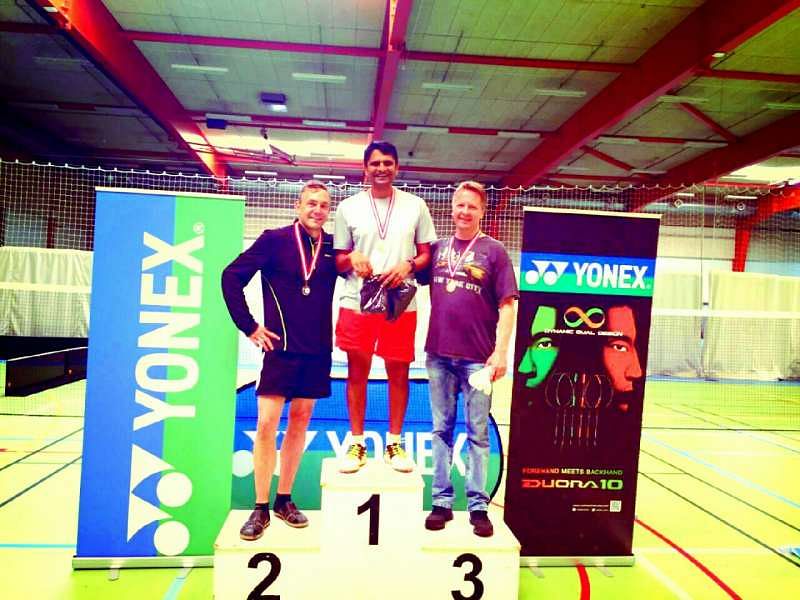
Pednekar was introduced to the sport by a fellow squash player Abhinav.
Speaking to SportsKeeda, he said:
“He gave me the interesting aspects of this sport and I got all the details through internet.I realised if I had to take part I need to have some strength in table tennis, a sport which was new to me. I gave myself six months to train hard and when I was confident I had touched reasonable level thought of my next step of participation.”
Ashutosh was already a keen squash and badminton player.
Can Ashutosh deliver on his promise of gold at the World Championships?
He replied:
“I have planned to sharpen my table tennis skills with a professional trainer and keep in good touch in the other three.”
Go well, Ashutosh, Lone Ranger of Indian Racketlon!
Lionel Messi retires from international soccer: Will he return?
What do you say to Lionel Messi when he loses yet another final and announces his retirement from internationals?
Are his fans to cry, “Come back, Messi, we’ll always love you, come what may”?
Or to join his plaintive chorus to ‘Don’t cry for me, Argentina’.
“Don’t cry for me Argentina
The truth is I never left you
All through my wild days
My mad existence
I kept my promise
Don’t keep your distance.”
Truth be told, my first reaction to Messi’s missed penalty was the demoralising effect it would have on his teammates. To see their skipper miss his shot by a mile could only create more flutters and nerves in their midst.
And sure enough, his teammates missed another and that was the end of Argentina’s Copa America Centenario dreams.
That Messi would take this loss to heart and view it as a personal failure could only be foreseen in hindsight.
Will Messi be back?
The magician with the ball does know that soccer is a team game and that he’s not expected to shoulder the blame for his team’s inadequacies. And it’s not as though there isn’t a blueprint available on how to nullify the Messi threat personified by an Argentinean side. Germany have done it before and Chile did it to them twice.
Messi is hardly the first high-profile player to miss a crucial penalty. His Real Madrid rival Cristiano Ronaldo missed one in this year’s Euro. Roberto Baggio and Michel Platini are on that unfortunate list too.
Time is a great healer and it’s possible that the lure of another World Cup could draw the mercurial forward back.
Yes, it’s possible, and we certainly hope to see him back in national colours.
Until then, we’ll continue to enjoy his exploits with Neymar and Luis Suarez for Barca.
Harvard Business School has a celebrity student—Maria Sharapova!
Maria Sharapova is full of surprises.
Just when her detractors and critics believed that she must be moping around waiting and hoping for the Court of Arbitration for Sport (CAS) to reduce or revoke her suspension, Sharapova—the magician—pulled out a rabbit from her proverbial hat.
The long-legged Russian beauty is going to school at Harvard.
The shrewd businesswoman that she is, Maria probably realised that time spent away from the court can be best utilised learning how to run her Sugarpova business better.
While it sounds like a wonderful idea, it’s also an opportunity for her to reflect on her particular situation.
James Blake who spent two years at Harvard but dropped out to pursue his tennis career had some advice for the suspended player.
Sharapova is the not the only woman player to opt for Business Administration when returning to studies.
Venus Williams is a Bachelor of Science in Business Administration at Indiana University East.
The tuition fees and living costs is small change for Sharapova who presides over a multi-million dollar empire.
The DNA India titled their report on the news flash:
Real woman of substance: Maria Sharapova to go to Harvard Business School
That seems a tad overdone but there are worse things Maria Sharapova could do away from the sport.
Update: Sharapova will be attending a two-week executive education program at Harvard—not the full-fledged MBA.
Her agent, Max Eisenbud, told The Associated Press that it involves just two classes on campus.
Read more at:
Anil Kumble: Surprise selection as Team India Coach

Indian cricketer Anil Kumble. (Photo credit: Wikipedia)
Anil Kumble is the newly appointed Team India coach.
That must be the most important job in the country after the Prime Minister’s, right?
Wrong, dead wrong.
Sanjay Manjrekar , in his column for The Week, describes the job thus:
“’Tell me, who is this guy with the Indian team, is he a player?’
‘No, he does not step onto the field.’
‘Is he a selector, does he pick the players?’
‘No, he does not, the captain and selectors do that.’
‘Okay, then, does he make the critical game-changing decisions on the field, with regard to bowling changes, field setting, batting order, etc?’
‘Nope, that again is done by the captain.’
There you go, that is the actual reality of an Indian coach and his position within the team. Hence the media excitement, every time, around the appointment of an Indian coach, baffles me.
In contrast, when a far more important and influential position outside the players is filled, it’s only duly noted by the media. That is the chief selector’s position.”
This is not to deride or belittle Anil Kumble’s credentials in any way.
Much has been said and written about his stellar cricketing record, his courage facing the West Indian quicks and his mental strength,
Kumble recognises the above reality and claims that he’ll be more of an ‘elder brother’ to the side.
He said:
“I certainly believe that as a coach of a young team, you need to be hands-on and you need to really get your hands dirty as well – train with them, be a part of their training. And be with them more like an elder brother, in every aspect, not just on the field, but also off it. That’s something I will be focusing on.”
Manjrekar concludes his piece thus:
“In Indian cricket, the captain and a couple of senior players basically chart the destiny of the Indian team. The selectors have an important role to play in this journey. If the captain is able, there is nothing wrong with this kind of culture; many great teams have been built like this.
So what an Indian coach really does is facilitate the needs of the captain and the core group and try and keep them in good spirits.
The coaches that actually make a difference to Indian cricket are those that coached players like Tendulkar, Dravid, and others, when they were kids. The grassroots level coaches.”
Kumble made a three-year-plan presentation to the Cricket Advisory Committee but has been appointed for only a year.
Ravi Shastri’s stint as Team Director and the results under his tutelage paved the way for the selection of an Indian coach.
Can Kumble prove as adept as John Wright or Gary Kirsten in handling this young side?
India play 13 Tests at home and his tenure includes the Champions Trophy.
‘Jumbo’ does not have a long rope and there is speculation that he was not an unanimous choice.
Kumble has no formal coaching experience but then neither had Shastri.
That appears to have made the difference since he was not in the initial shortlist.
The CAC selected Kumble—possibly—because he is a much younger candidate and can keep pace with the youngsters in the side. John Wright and Gary Kirsten were not too long retired when they took over the reins of the Indian side.
A younger person can be more hands-on; Kumble certainly believes he can be.
Is hands-on what the job requires? Depends on how you define it. Kirsten felt that it played an important role while he was coach. He used to spend hours bouncing balls at the senior players. His ability to handle fragile super-egos cannot be underestimated.
Kirsten’s right if we are go by what Manjrekar writes. And he is an expert.
Players like Virender Sehwag and Virat Kohli prefer to consult their old coaches on technical aspects of their skills.
Is it less likely that it’s not the same for the current batch of players? Ajinkya Rahane and Robin Uthappa have retained Pravin Amre as their go-to person for improving their willow skills.
It does appear that what a coach brings to the side is intangible but the results are visible and rewarded or penalised with much more alacrity.
Simply put, the coach is the fall guy should anything go wrong.
Lionel Messi cannot mess it up this time
Will it be third time lucky for Lionel Messi?
The mesmerising Argentinean played his part in thumping hosts USA in the semis of the Copa America Centenario with one stupendous free-kick and two assists.
The men in striped white and blue take on defending champions Chile in a rematch of last year’s summit clash.
This is Messi’s third final in two years for his nation.
Will this end their title drought?
The line-up for the last four places were as the form book suggests.
Colombia and USA made up the numbers.
Brazil—minus Neymar—were a pale shadow of their former, glorious selves. And Uruguay were unfortunate that they had to leave their talismanic striker Luis Suarez on the injury bench.
100 years of the Copa America and there couldn’t be a more befitting end if Lionel Messi were to finally acquire the silverware he richly deserves.
Alexis Sanchez may have dissimilar thoughts.
Who’s going to Rio? Mary Kom or Vijender or neither? (Updated)
Shiva Thapa is the sole Indian boxer to qualify for this year’s Olympics so far.
There could be a few more if results are favourable at AIBA’s World Qualifying tournament in Baku.
However, there are two boxers—both former Olympians, both former medallists—-who are hoping for indirect entry to Rio.
They are Mary Kom and Vijender Singh.
While Kom failed to qualify, Vijender turned professional last year. That ought to have ended his bid for yet another medal but he was provided a glimmer of hope when AIBA opened their doors to pros earlier this month.
Singh, however, has a WBO Asia Pacific title bout scheduled for July 16 in New Delhi against Kerry Hope.
That effectively belied his Olympic aspirations—or so, we believed. The professional boxers qualifying tourney is scheduled a week earlier in Venezuela.
But Vijender has other ideas.
Speaking from Manchester, the former three-time Olympian said:
“Why can’t there be a wild card entry for me? Why can’t the ad-hoc committee demand the same for me from the AIBA? They are making every effort to get a wild card for Mary Kom despite the fact that she has not qualified for Rio. But in my case, there is a clear bias because no one in India is serious about my Olympic participation.
I should also be given a chance if the rules have been relaxed by the AIBA for pro boxers to compete at Rio. I am a three-time Olympian and have fought in Commonwealth Games, Asian Games as well as World Championships.”
Vijender believes he is being discriminated against because he is now a professional pugilist.
He added:
“It seems that I am no longer competing for India. The officials believe that since I have turned pro, I shouldn’t have a chance of going to Rio. They feel they shouldn’t help me because I no longer represent India in amateur boxing. I am fighting my professional bouts under the tri-colour. My name is announced as ‘Vijender Singh from India’. All my victories in the pro circuit are for India. My Asian title bout will be for India.”
Welcome back to the merry go round of Indian sportingdom, Vijender.
And it is a merry-go-round.
Mary Kom is being forced to run from pillar to post just to ensure that the Indian Olympic Association files an application for a wild card entry with the International Olympic Commission.
Three wild card entries under the Tripartite Commission Invitation Places are up for grabs in three women’s weight categories — 51kg, 60kg and 75 kg.
These are usually used to promote sport in certain countries.
The IOC can allocate these to players of repute who fail to qualify.
But either the national federation or the national Olympic body has first to apply for a wild card entry.

Vijender singh at the sahara indian sports award (Photo credit: Wikipedia)
That, unfortunately in Kom’s case, has not yet occurred.
The DNA listed the criteria for Invitation Places as follows:
-
“National Olympic Committee (NOC) priority: based on NOC preferences, as specified in the applications submitted
-
International Federation (IF) priority; based on the assessment of the athletes’ technical level and sporting merit during the qualification period
-
International Olympic Commission (IOC) priority; based on various principles in relation to the objectives of the commission, including:
-
Universality
-
Continental balance
-
Gender equity
-
NOC and athlete eligibility
-
Technical level to compete safely and with dignity
-
Olympic scholarships for athletes”
All this while the IOA’s first choice as Goodwill Ambassador, Salman Khan, steals the limelight with his ill-timed and ill-advised remark comparing his bodily aches post the intense workouts he endured shooting for his upcoming film ‘Sultan’ to those of a ‘raped woman’.
How much better it would have been had Salman Khan spoken a few words highlighting the travails that Indian sports persons undergo merely to participate in an Olympics.
That’s what ambassadors are for, that’s what they do.
–––––—-+++±+++++++++++++++
Mary Kom’s application for a wild card entry has been rejected by AIBA. The IOC does not permit wild cards to players from nations who have eight or more representatives in a sport. India fielded eight or more boxers at the last two Games.
Number of readers subscribed
Read it on Apple News

Read it on Apple News
Stat Counter
 Sports, Health and Exercise
- An error has occurred; the feed is probably down. Try again later.
 Make Time For Sports.