Make Time For Sports.
India
Sanjay Manjrekar: Lack of customers
“If Test cricket was a shop, it would have been shut down a long time ago for lack of customers.”
—Sanjay Manjrekar.
Is Shobhha De completely out of kilter? Not really!
Shobhha De’s series of ‘well-timed’ tweets deploring Indian athletes’ performances at the Olympics was roundly castigated by the Twitteratti with Abhinav Bindra and Sachin Tendulkar joining the discordant chorus.
Sachin Tendulkar:
“The athletes give their best in their efforts to win a medal. All the Indian athletes in Rio 2016 have my support. They work for years and years but when you miss out narrowly, you obviously feel bad.
When the results don’t go your way, that is when you need to support them.
The first half didn’t go our way but you have to support them when the chips are down.”
But there can’t be smoke without fire (not unless it’s dry ice, of course).
Five days into the Games and the medals tally still shows nought against India’s listing.
The shooters have disappointed sorely with only Abhinav Bindra coming close to a bronze and Dipa Karmakar making the vault final in gymnastics.
The archers continue to keep Indians back home waiting for their maiden medal despite years of selection and training to promote this ancient art and its modern avatar.
The London Olympics saw India claim six medals—two in shooting, two in wrestling and one each in badminton and boxing.
The expectations were that the Indian contingent of 119 would clinch at least seven this time.
That’s less than a six per cent chance of a medal for our sports-persons.
Is that what’s to be expected from our competitors—that 94 per cent of them are to be no-hopers and just make up the numbers and soak in the sights?
Admittedly, the qualification marks have been made stiffer in recent times and for most Indian athletes from sports other than cricket, a chance to participate in the Olympics is the highlight of their low-storied careers.
But surely we can and should demand more from them. Surely at least 25% of them should be realistic medal contenders and the rest should be earmarked as talents for the future sent to assimilate the ethos and pressure of the Games so that they are not overcome with stage fright the next time around.
The qualification marks too could be made a lot more stringent than the minimum needed.
Yes, De’s remarks were ill-advised and probably nothing more than a publicity stunt. It’s a wonder whether our Indian athletes would worry too much about a socialite columnist otherwise.
Perhaps, it’s time Ms. De penned a novella on the state of Indian sport and its heroes (and heroines) rather than her much-beloved Bollywood which conversely draws significant inspiration (and box-office success) from the annals of Indian sport in recent times.
Related articles
 Indians Immune to Olympic Fever(newsweekpakistan.com)
 All eyes on Rio as India aim for record medals tally(freepressjournal.in)


Nita Ambani is now India’s only active individual member at the IOC
Nita Ambani, sports promoter and founder chairperson of Reliance Foundation, is now an International Olympic Committee (IOC) member.
Firstpost—a Reliance group publication—termed Ms. Ambani’s election as “carrying forward the country’s flag in the Olympic Movement.”
The first lady of the Reliance group was voted in as an individual member in Rio on Thursday polling 92.2% valid votes among eight candidates.

The seat of the International Olympic Committee in Lausanne (Photo credit: Wikipedia)
What does being an individual member entail?
The Olympic website states:
“The IOC members, natural persons, are representatives of the IOC in their respective countries, and not their country’s delegate within the IOC. As stated in the Olympic Charter: ‘Members of the IOC represent and promote the interests of the IOC and of the Olympic Movement in their countries and in the organisations of the Olympic Movement in which they serve.’”
So it’s not really a victory for the nation per se—if one wants to nitpick—but actually a shrewd move both by Nita Ambani and the Olympic Committee.
Evidently the committee considers India to be an important cog in its scheme of matters in years to come.
And Nita Ambani gains some legitimacy in the eyes of her numerous detractors and critics who consider her a privileged interloper in the world of Indian sport—not that she cares.
She said:
“I am truly humbled and overwhelmed to be elected by the IOC. This is a recognition of the growing importance of India in the world stage and a recognition for Indian women.
I have always believed in the power of sport to shape our youth. I believe that sports brings together communities, cultures, and generations has the power to unify and unite people. I look forward to spreading the spirit of Olympics and sports across our nation.
I’m working really with multi-sports in India. We want to encourage many other games besides cricket in India like football and basketball and let children be exposed to all kinds of games. So I’m looking forward to building a movement in sports for children in India.’’
She is the only current active Indian member in the IOC and the first Indian woman.
Former Indian Olympic Association Secretary General, Randhir Singh, is an honorary member.
The IOC has 90 members, 36 honorary members and 1 honour member.
Honorary members are usually former members.
Dr. Henry Kissinger is the only honour member of the Committee.
Related articles
 WADA in the crosshairs, as IOC members fume at late response(dailystar.com.lb)
 IOC session supports decision not to ban Russian athletes from Rio(tass.ru)
 Fast Facts and Stats: A Selection of Olympic Research and Reference Resources(infodocket.com)
 IOC pays tribute to Israeli victims of 1972 Munich attack(herald-review.com)
 International Olympic Committee clears all 11 Russian boxers to compete in Rio(onenewspage.us)
 Olympics: IOC chief urges total review of world anti-doping system(channelnewsasia.com)
 IOC members bash world anti-doping body over Russia scandal(wistv.com)
 Russian Boxing Team Cleared To Compete In Rio(rferl.org)


Narsingh Pancham Yadav found innocent by NADA disciplinary panel: Is he home free?
Narsingh Pancham Yadav can consider himself very, very fortunate.
Few expected National Anti-Doping Agency’s (NADA) disciplinary panel to be lenient with the grappler from Mumbai.
But NADA have been benevolent in ruling in favour of the 26-year-old wrestler exonerating him—giving him the benefit of the doubt— by accepting his version of sabotage by a fellow competitor.
Section 10.4 of NADA’s Anti-Doping Rules (2015) states:
10.4 Elimination of the Period of Ineligibility where there is No Fault or
Negligence
If an Athlete or other Person establishes in an individual case that he or she bears No Fault or Negligence, then the otherwise applicable period of Ineligibility shall be eliminated.
[Comment to Article 10.4: This Article and Article 10.5.2 apply only to the imposition of sanctions; they are not applicable to the determination of whether an anti-doping rule violation has occurred. They will only apply in exceptional circumstances, for example where an Athlete could prove that, despite all due care, he or she was sabotaged by a competitor.
Conversely, No Fault or Negligence would not apply in the following circumstances: (a) a positive test resulting from a mislabelled or contaminated vitamin or nutritional supplement
(Athletes are responsible for what they ingest (Article 2.1.1) and have been warned against the possibility of supplement contamination); (b) the Administration of a Prohibited Substance by the Athlete’s personal physician or trainer without disclosure to the Athlete
(Athletes are responsible for their choice of medical personnel and for advising medical personnel that they cannot be given any Prohibited Substance); and (c) sabotage of the Athlete’s food or drink by a spouse, coach or other Person within the Athlete’s circle of associates (Athletes are responsible for what they ingest and for the conduct of those Persons to whom they entrust access to their food and drink). However, depending on the unique facts of a particular case, any of the referenced illustrations could result in a reduced sanction under Article 10.5 based on No Significant Fault or Negligence.]
Had Yadav been found guilty, he would have been banned for the full period of four years.
Yadav and his fellow wrestlers celebrated by partaking of sweets outside the agency’s office.
But it’s not all clear for Rio as yet.
Chander Shekhar Luthra of DNA writes:
“…World Anti-Doping Agency (WADA) has so far refused to bow down to allegations of ‘sabotage’, keeping in mind that such a decision could well cause an irreparable loss to the ‘battle against doping’ at the international level.”
A retired Nada official said:
“What if the entire Russia stand together and say there was a deep conspiracy against their 100 athletes? What if Maria Sharapova now cites the ‘conspiracy’ angle by her opponents in her case that is being heard by Court of Arbitration in Sport (CAS)?”
NADA’s rules state that appeals can be filed to both CAS and the National Anti-Doping Appeal Panel within a period of 21 days.
The latter’s unlikely—it would be tantamount to NADA challenging its own decision—but appeals can be made to CAS by WADA, the international Wrestling Federation United World Wrestling and the IOC; there exists no other apparent affected party in the above proceedings.
NADA lawyer Gaurang Kanth complained “he was not allowed to cross-examine Narsingh on the sabotage angle”.
Yadav had tested positive for the anabolic steroid — methandienone — in both his A and B samples.
NADA DG Naveen Agarwal read out the panel’s verdict:
“We kept in mind that in the past, till June 2, none of his samples were positive. It was inconceivable that one-time ingestion would be of benefit. Therefore the panel is of the view that the one-time ingestion was not intentional.”

Sushil Kumar, World champion (2010) and Beijing Olympics bronze medalist Indian wrestler, attending annual sports meet of GGSIPU, Delhi as a chief guest. (Photo credit: Wikipedia)
Jitesh Kumar,the 17-year-old accused of spiking Yadav’s drinks is a trainee at Delhi’s Chhatrasal Stadium. Two-time Olympic medallist Sushil Kumar supervises the wrestlers there. An FIR has already been filed by Yadav at the Rai police station in Haryana.
Related articles


Societe Generale and Puma to sponsor rugby in India
Is rugby the next sport set to take off in India?
One would hope so given that French financial services major Societe Generale announced a long-term partnership with Rugby India to promote the game in the country.
SG will not just be a financial partner but also the title sponsor for the Indian National Rugby Sevens Team’ across all categories — senior, junior and women.
Societe Generale will also support World Rugby’s ‘Get Into Rugby’, an initiative to teach the game in schools and introduce children to the sport.
Puma have joined the bandwagon as well providing kits to the men’s and women’s teams.
All this went down at the Bombay Gymkhana on Thursday the 28th of July, 2016.

Flag of Bombay Gymkhana, a popular club in Mumbai (Photo credit: Wikipedia)

Bombay Gymkhana main corridor (Photo credit: Wikipedia)
The deal is initially for a period of three years.
Rugby is being reinstated at the Rio Olympics this year after a gap of 92 years.
And Japan is set to be the first Asian country to host the World Cup in 2019.
India is currently ranked 12th among 32 Asian countries who take part.
Aga Hussain, VP of Asia Rugby, believes that India can break into the top five in the next five years.
Solar Energy company PROINSO have also signed a sponsorship deal with the Indian Rugby Football Union (IRFU).
Rugby has over 44,000 registered players in the country.
The game was first played in India in 1871.

Europeans playing rugby football in Calcutta. Note – lack of Indian people, round (rather than oval) ball, unusual clothing and goal posts. Several of the players appear to be Welsh (hence the dragon) (Photo credit: Wikipedia)
The national team, however, was not formed until 1998. Their first game was against Singapore.
They were inducted into the International Rugby Board only in 2001.
India have never qualified for the Rugby World Cup.
If rugby in India has a profile, it’s mostly due to Bollywood star, Rahul Bose, who represented India for almost 25 years.
Bose played 20 international matches but hung up his boots in 2008.
On his retirement, Bose said:
“Preparing and playing international rugby takes around two months which I don’t have on me now. I have to travel for film festivals, give lectures, I’m on the board of six NGOs and besides I also have my films. Rugby doesn’t pay you well and besides, the youngest player in the team is 18. I must have played with their fathers in school. I’m 40 now, so the signs are loud and clear that I should quit before I start playing with my friends’ children on the team.”
On what he gained from playing the sport:
“Like how to lose gradually and enjoy the score, not the result; to be a team player, because by nature I am an individualist; if you try to play alone, you are bound to get hurt; and, to have a hot heart and keep a cool head. Today we rank 81st among 110 countries and 50 years later, we will rank in the top 20 position. We will be part of the CommonWealth Games, too, but I will be a grandfather by then.”
Bose, of course, was present at the press conference announcing the tie-up with Societe General and Puma India as evidenced by the post below.
Bose need no longer be pessimistic about the state of Indian rugby.
Things are looking up for sport in India and rugby in particular.
Related articles
 Super Rugby breaking new ground in the southern hemisphere with first female match official(walesonline.co.uk)
 Pools announced for Rio 2016 sevens tournament(voxy.co.nz)
 U.S. draws same group as Fiji for Olympic rugby(espn.go.com)
 Draw made for 1st Olympic rugby in 92 years(sandiegouniontribune.com)
 South Africa in the News on 29 June 2016(myza.co.za)
 Favourites Fiji to face hosts Brazil in rugby sevens(sbs.com.au)
 Olympics: Favourites Fiji to face hosts Brazil in rugby sevens(sports.yahoo.com)


Narsingh Yadav: Culpable or not?
The entire sorry episode of Narsingh Yadav’s failed dope test and his subsequent disqualification this year’s Rio Olympics reads like a really bad Dick Francis thriller .
Yadav claims that he is the victim of a conspiracy, that his food and supplements were spiked by mischievous elements. An investigation by India Today appears to bear out his version. There are reports of an intruder mixing an unidentified white, powdery substance in his food portions.
Suspicion is rife given that his roommate Sandeep Tulsi Yadav too has tested positive for steroids. Were they made patsies by unscrupulous persons?
Yadav is reportedly shattered by the turn of events and is said to have contemplated killing himself.
It all seems tragically anti-climactic given the court drama pursuant to the non-selection of Sushil Kumar and Yadav’s ‘meritorious‘ showing.
Accusations and counter-accusations will continue to fly over the next few days—at least, until Indian athletes reach Rio.
Is Yadav being victimised by powerful parties within the SAI? Or is he simply unwilling to admit any wrongdoing?
Surely, the Indian public deserves to know.
Vijender Singh: Boxing anger
“In boxing, if you get angry toh aur zyada maar padegi ring mein. It’s all about doing your bit and winning points. Why take unnecessary panga, get angry and waste your energy?
—Vijender Singh.
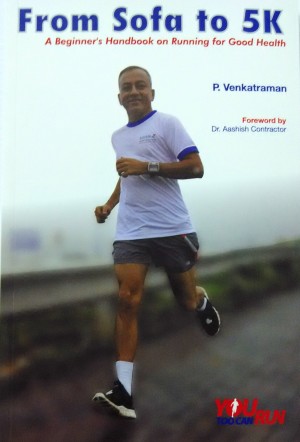
From Sofa to 5k: A Review
“In the morning of 3rd February, 2007, I was lying naked on a cold metal table. My entire body was being shaved, except the head. I was joking with the hospital attendant that this was a contrast to the tonsure at Tirupati, where the head was shaved and the body hair left untouched!
I was praying hard to HIM that my Coronary Artery Bypass Graft procedure (CABG aka Open Heart Bypass Surgery) should go well. So were my family members who had assembled outside.”
Thus begins the preface of P. Venkatraman’s book, “From Sofa to 5K: A Beginner’s Handbook on Running for Good Health” with a foreword by renowned cardiologist Dr. Aashish Contractor who is also an avid long distance cyclist and runner.
Contractor concludes his foreword as below:
“May fortitude hasten you and let temperance chasten you.”
Venkatraman outlines his story in the prologue describing his family history of heart disease beginning with his grandfather. His father and younger brother too were similarly affected.
Venkat details how he was always health and diet-conscious throughout his early life.
The author began running in 2004 and by the very next year was completing half-marathons. All this physical activity, however, could not prevent a 100% blockage of his left artery. And in Feb 2007, Venkatraman underwent heart surgery.
In January 2008, he ran the Mumbai half-marathon once more highlighting the second coming of the inspirational founder of You Too Can Run.
You Too Can Run’s mission is ‘To Promote Running For Good Health’.
Venkatraman divested his stake in one of India’s largest BPOs where he was a Promoter Director and founded his social enterprise.
The book is an attempt to inspire others to take up running for their health and is published by You Too Can Run Sports Management Private Limited who have registered themselves as a publisher with the HRD Ministry.
Chapter 5 onwards tackles the actual subject of running for beginners.
IITian and running coach Daniel Vaz is the technical editor of the book while nutritionist Kinita Kadakia is a major contributor to sections dealing with weight loss.
Venkatraman initially lists the psychological, social and physiological reasons for running.
There follows an entire chapter devoted to getting started—the most interesting part is how to handle aggressive stray dogs.
Chapter 7 deals with progressive loading and has a beginner’s 5K running plan pull-out.
Most beginners are astounded that they don’t start losing pounds immediately or sometimes for quite a while despite being quite regular and disciplined with their exercise programme. Kadakia answers these questions in the chapter ‘Running and Weight Loss‘ and how losing weight is simply about burning more calories than you consume i.e. a calorie deficit has to be created and maintained.
Finally, ‘Staying Motivated‘ is simply about that—how to keep oneself going and how it all begins with setting a goal.
The book also provides a Daily Health Log sheet that helps runners cultivate a habit of checking their progress towards their goals.
The book is of value specifically to someone who wishes to start a running regimen.
Recommended for beginners—you could do worse.
Related articles
 Physical activity boosts kids’ brain power and academic prowess(ukedchat.com)
 Making time to exercise #FridayReflections(mumbaionahigh.com)
 Women’s Fitness – Why Do You Want to Train?(merrell.com)
 Exercise Helps Children Learn, Make Better Grades In School: Experts(techtimes.com)
 Exercise ‘can help improve brain’(yorkshirepost.co.uk)
 Physical Activity Primes Children’s Brains For Academic Excellence, Finds Study(medicaldaily.com)
 Healing heart(tns.thenews.com.pk)


Vijender and Ronaldinho: Commonality of skill and genius
Professional sports is not always about speed and power.
It’s also about skill, precision and deception.
Nothing illustrated this better than Vijender Singh’s performance during his WBO Asia title bout against Australian Kerry Hope and Ronaldinho’s in the Premier Futsal game for Goa against Bengaluru.
Hope was the more aggressive of the two seeking to flatten Singh with his left jab and powerful right. But Vijender absorbed it all and retaliated with counterpunching of his own—Hope’s only response was to engage in ‘professional’ clinching of the worst kind.
It was the Haryanvi’s first 10 rounder but he withstood the onslaught of a man who had run a half-marathon in 1:35 just two weeks earlier.
Admittedly, it was not a very entertaining encounter. Perhaps, boxers and students of the sport would appreciate it better.
The result, though, was an unanimous decision in Vijender’s favour.
Unlike his earlier six fights, this did not end in a knockout. The prize, however, was his.
Ronaldinho retired from international football last year.
Futsal is his second coming.
The happiest soccer player on the planet was in his element in the game against Bengaluru on Sunday scoring five out of seven goals for his side.
The Brazilian displayed his entire repertoire in a spirited performance that left the crowd astounded and his fans in delirium.
Two exponents of the art of two different games but a common thread shone through them.
Experience counts for something—after all.
Sultan: Another megahit for Salman Khan, puts wrestling on Bollywood map
Rating: 3 stars out of 5
Language: Hindi
Directed by:
Ali Abbas Zafar
Produced by:
Aditya Chopra
Written by:
Ali Abbas Zafar
Screenplay by:
Aditya Chopra
- Salman Khan as Sultan Ali Khan
- Anushka Sharma as Aarfa Ali Khan née Hussain
- Anant Vidhaat Sharma as Govind/Sultan’s friend
- Meiyang Chang as Pro Takedown host
- Randeep Hooda as Fateh Singh/Sultan’s coach
- Amit Sadh as Aakash, Pro Takedown founder and Sultan’s presenter
- Tyron Woodley as Tyron (Himself) (wrestler)
- Marko Zaror as Marcus, the finalist wrestler.
- Kumud Mishra as Barkat Hussain
Akash Oberoi’s mixed martial arts (MMA) league is in trouble. He needs a fighter who can draw in an Indian audience and fast.
His father recommends the name of Sultan—a middle-aged wrestler—living in a small town in Haryana.
Akash meets Sultan only for the fighter to reject his offer claiming that he has given up wrestling forever.
Oberoi is flummoxed and meets Sultan’s associate Govind to learn what he can do to change Sultan’s mind.
Thus begins the flashback into the story of Sultan’s past—his romance with Aarfa Ali Khan, his initiation into the sport in order to impress her (no mean wrestler herself) and her father and how he becomes the supreme wrestler of his time and era.
The duo light up the wrestling world earning plaudits at the Asian and Commonwealth Games. Both are scheduled to participate in the 2012 Olympics but Arafa becomes pregnant just before the Games. She stays home while her spouse goes on the represent India at the Games and clinch gold.
Sultan becomes egoistic after his many-layered success believing that he cannot be beaten by anyone except himself.
He refuses to participate in grassroots level mud akhada tournaments and leaves home once more for the World Championships.
He wins gold but is shattered on learning that his new-born son afflicted with anaemia lost the fight for life in his absence. The doctors could not find anyone with his rare blood type (O Rh –ve)—a blood group Sultan shares.
Sultan—with his hockey stick—knocks over the head of the statue dedicated to his Olympic triumph.
The couple separate. Thus begins the second phase of Sultan’s life—a descent into obscurity and petitioning local politicians to approve the founding of a blood bank in the town.
Akash seizes upon Sultan’s requirements and promises him that the cash earned by fighting in his MMA league will deliver his desired dream of a blood bank named after his son.
Sultan undergoes strenuous training under Fateh Singh—a blacklisted MMA fighter—and learns the ropes of the new sport.
Sultan is thoroughly thrashed by every opponent but defeats them by outlasting them and throwing them over with his classic akhada moves.
In typical Bollywood style, the fight scenes and background score tug at the heartstrings and Sultan is reconciled with Arafa when he is critically injured in the semis. Disregarding medical advice, Sultan fights on and emerges victorious in the final round.
Sultan visualizes Marcus as his younger, arrogant self depicting the maxim that man’s biggest victory is over himself.
Sultan launches a blood bank with his prize money and is reunited with his wife who resumes wrestling. Some years later, they are blessed with a baby girl whom Sultan starts training in the sport.
Highlights of the movie:
Sultan’s gloves imprinted with the words ‘Venum’.
Sometimes you wish Sultan would just stay down after absorbing the kind of punishment he does at his age. MMA is a young man’s sport and the storyline is all pathos with very little logos.
Can you imagine that an Olympic Gold wrestler would find it hard to raise funds for a blood bank? State and central governments should be falling over themselves to support any such endeavour. Had Sultan’s return to the ring had been an attempt at redemption, it could have resonated more with the audience. But maybe that’s been overdone and clichéd.
Dialogues delivered in earthy Haryanvi seem to be literal translations of inspirational English quotes.
The movie is populated with product placements—the most prominent one is Videocon’s D2H placed quite strategically at the back of Sultan’s scooter.
Songs are largely forgettable.
While there is no glossing over Arafa’s sacrifice and dismay at learning that she’s on the cusp of motherhood, one felt that Anushka could have portrayed her angst better and that it is perhaps the beginning of the rift between husband and wife.
Salman Khan’s scene where he tears off his shirt to self-loathingly view his pot-bellied self in the mirror is perhaps his best attempt at method acting ever.
Randeep Hooda as Fateh Singh is impressive.
A must see for Salman fans—they don’t need reviews anyway.
Number of readers subscribed
Read it on Apple News

Read it on Apple News
Stat Counter
 Sports, Health and Exercise
- An error has occurred; the feed is probably down. Try again later.
 Make Time For Sports.