Make Time For Sports.
Test
Is Lokesh the next Dravid?
Mohinder Amarnath, in his latest column, anointed Lokesh Rahul as the next Rahul Dravid.
He may be right, he may be wrong.
Much earlier, Cheteshwar Pujara was Dravid’s logical successor.
Then, it was Ajinkya Rahane.
Now, it’s KL.
It’s never easy to step into the shoes of colossuses.
I’m sure each of the above would rather be recognised for themselves rather than somebody’s clone.
And it will take some doing to match Dravid ‘s feats and consistency over a sustained period of time.
Greatness doesn’t occur overnight.
In some way, Dravid seems a little short-changed by these comparisons.
Is it because his achievements are the result of constant improvement, endeavour, discipline, technical correctness and correct temperament rather than simply genius, wristiness or off-side godliness?
No one points to any of the current lot and claim that they’re the next Tendulkar, Ganguly or Laxman.
Comparisons are sometimes drawn between Kohli and Tendulkar, but the Indian test skipper has etched out a stellar place for himself.
Coming back to the question, is Lokesh the next Dravid?
He’s surely the next Rahul.
Sanjay Manjrekar: Lack of customers
“If Test cricket was a shop, it would have been shut down a long time ago for lack of customers.”
—Sanjay Manjrekar.
Anil Kumble: Surprise selection as Team India Coach

Indian cricketer Anil Kumble. (Photo credit: Wikipedia)
Anil Kumble is the newly appointed Team India coach.
That must be the most important job in the country after the Prime Minister’s, right?
Wrong, dead wrong.
Sanjay Manjrekar , in his column for The Week, describes the job thus:
“’Tell me, who is this guy with the Indian team, is he a player?’
‘No, he does not step onto the field.’
‘Is he a selector, does he pick the players?’
‘No, he does not, the captain and selectors do that.’
‘Okay, then, does he make the critical game-changing decisions on the field, with regard to bowling changes, field setting, batting order, etc?’
‘Nope, that again is done by the captain.’
There you go, that is the actual reality of an Indian coach and his position within the team. Hence the media excitement, every time, around the appointment of an Indian coach, baffles me.
In contrast, when a far more important and influential position outside the players is filled, it’s only duly noted by the media. That is the chief selector’s position.”
This is not to deride or belittle Anil Kumble’s credentials in any way.
Much has been said and written about his stellar cricketing record, his courage facing the West Indian quicks and his mental strength,
Kumble recognises the above reality and claims that he’ll be more of an ‘elder brother’ to the side.
He said:
“I certainly believe that as a coach of a young team, you need to be hands-on and you need to really get your hands dirty as well – train with them, be a part of their training. And be with them more like an elder brother, in every aspect, not just on the field, but also off it. That’s something I will be focusing on.”
Manjrekar concludes his piece thus:
“In Indian cricket, the captain and a couple of senior players basically chart the destiny of the Indian team. The selectors have an important role to play in this journey. If the captain is able, there is nothing wrong with this kind of culture; many great teams have been built like this.
So what an Indian coach really does is facilitate the needs of the captain and the core group and try and keep them in good spirits.
The coaches that actually make a difference to Indian cricket are those that coached players like Tendulkar, Dravid, and others, when they were kids. The grassroots level coaches.”
Kumble made a three-year-plan presentation to the Cricket Advisory Committee but has been appointed for only a year.
Ravi Shastri’s stint as Team Director and the results under his tutelage paved the way for the selection of an Indian coach.
Can Kumble prove as adept as John Wright or Gary Kirsten in handling this young side?
India play 13 Tests at home and his tenure includes the Champions Trophy.
‘Jumbo’ does not have a long rope and there is speculation that he was not an unanimous choice.
Kumble has no formal coaching experience but then neither had Shastri.
That appears to have made the difference since he was not in the initial shortlist.
The CAC selected Kumble—possibly—because he is a much younger candidate and can keep pace with the youngsters in the side. John Wright and Gary Kirsten were not too long retired when they took over the reins of the Indian side.
A younger person can be more hands-on; Kumble certainly believes he can be.
Is hands-on what the job requires? Depends on how you define it. Kirsten felt that it played an important role while he was coach. He used to spend hours bouncing balls at the senior players. His ability to handle fragile super-egos cannot be underestimated.
Kirsten’s right if we are go by what Manjrekar writes. And he is an expert.
Players like Virender Sehwag and Virat Kohli prefer to consult their old coaches on technical aspects of their skills.
Is it less likely that it’s not the same for the current batch of players? Ajinkya Rahane and Robin Uthappa have retained Pravin Amre as their go-to person for improving their willow skills.
It does appear that what a coach brings to the side is intangible but the results are visible and rewarded or penalised with much more alacrity.
Simply put, the coach is the fall guy should anything go wrong.
Ravi Shastri: What he said, really meant and definitely didn’t
Ravi Shastri is no Mad Hatter.
What he said:
“When the moment is important, Ravi Shastri is the last one to back away. So if you’re asking if my hat is in the ring, it is in there. Maybe three hats!”
Ravi Shastri’s tenure as Team India director has ended. He and his team— Sanjay Bangar, Bharat Arun and R Sridhar—have done a creditable job following Duncan Fletcher’s departure.
When asked if he’d be up for the job of the new team coach, the former left-arm spinner and right-hand bat responded:
“I have had a discussion much earlier with the Board on as to where things should go, and how. At the end of the day, they are my employers. They are the ones who are going to make the decision. So whatever I have grasped in these 18 months, I have let them know.
See, it is a very challenging job. It has been a very enjoyable job. It is a very important moment in Indian cricket.When the moment is important, Ravi Shastri is the last one to back away. So if you’re asking if my hat is in the ring, it is in there. Maybe three hats!”
Talking about Team India’s performance, Shastri is against change for its own sake.
He said:
“Look at our performances in the last 18 months. We are ranked 2, 2 and 1 in the three formats. And that can’t happen if you have people within the system who are not interested in the game. If, by any chance, it was the other way around, you would have heard from me straight.”
On how he handled coming into the fray as Team Director:
“I want to cut across barriers and come straight to the point, which is communication and trust. For me, that was the first nail I had to put in. I always believed they were a terrific side. They were low on confidence and they were probably not approaching the game in the right way, the way it should be played when you consider the talent they have.
Those were the two areas you had to focus on, and you kept things simple. You said, let’s hit those areas first, let’s get the trust, let’s get the communication going. Let’s get the work ethic better, where there’s no shortcut. It might take time, it might take three to four months before we are back to winning ways. And then you know things will fall in place. But what I saw was a transformation that was quite immediate. I didn’t expect that. But then again, it’s why I jumped in, because I knew there was huge talent there.”
What he really meant:
“I’m all for continuing as team coach. My record speaks for myself. And I’m always up for the challenge. It’s certainly something I enjoy doing more than commentating!”
What he definitely didn’t:
“Speaking of myself in the third person, now, that’s something I never did on the microphone. And I’m all for three hats: Commentator, Manager and Team Coach. To hell with conflict of interest , I’m Superman!”
Stats and Graphs: Kohli versus Ponting, Tendulkar and Lara

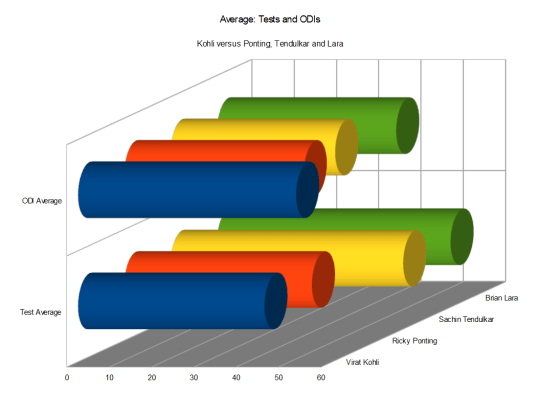
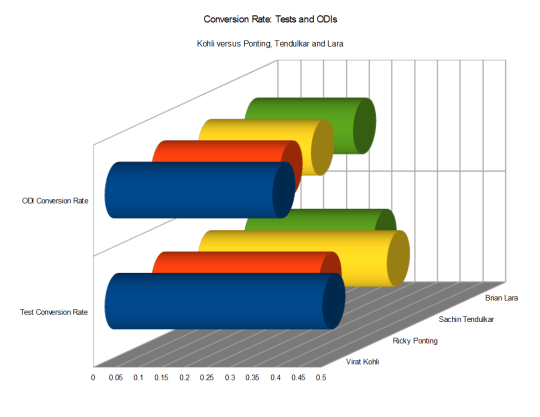
| Tests | ||||||
| Player\Statistics | Runs | Average | Best | 100s | 50s | Conversion Rate |
| Virat Kohli | 2994 | 44.02 | 169 | 11 | 12 | .48 |
| Ricky Ponting | 2481 | 44.3 | 197 | 7 | 12 | .37 |
| Sachin Tendulkar | 2911 | 54.92 | 179 | 10 | 14 | .42 |
| Brian Lara | 3751 | 55.16 | 375 | 8 | 20 | .29 |
| ODIs | ||||||
| Player\Statistics | Runs | Average | Strike Rate | 100s | 50s | Conversion Rate |
| Virat Kohli | 7212 | 51.51 | 89.97 | 7 | 12 | .37 |
| Ricky Ponting | 6143 | 42.37 | 77.56 | 13 | 33 | .28 |
| Sachin Tendulkar | 5828 | 38.85 | 82.58 | 12 | 36 | .25 |
| Brian Lara | 6433 | 42.32 | 79.12 | 13 | 41 | .24 |
Source:http://www.livemint.com/Leisure/zFN5uZLt2L57BBh01TH2AI/Kohli-and-crickets-modern-greats.html
Why best friends don’t necessarily make best teammates
Once upon a time, Shane Warne and Steve Waugh were fast friends.
As part of the mighty Australian side of the 1990’s and 2000’s, they were unconquerable, united in victory presiding over the world of cricket.
Right?
Wrong!
Shane Warne, in a reality show, called his former skipper “the most selfish cricketer I have played with”.
The reference was to his axing from the final Test in 1999 when the ‘kangaroos’ toured the West Indies.
Waugh initially preferred not to respond issuing a curt statement that read:
“I’m not justifying his comments with an answer.”
He later opened up to Triple M commercial radio.
He said:
“To be fair, not only Shane, any player I had to tell was dropped wasn’t easy. It wasn’t easy telling Adam Dale he was dropped for a Test match or Greg Blewett. There were a number of players I had to tell they weren’t playing. As a captain, that is the hardest thing to do. But it’s also why you’re the captain, because people expect you to make the tough decisions for the benefit of the team. You have got to do that at times and you have got to be prepared not to be liked by everyone.”
He added:
“I guess, the main thing as a captain and leader, as long as people respect your decision, that is all you can ask. You have got to take a bit of a risk sometimes. It’s not always the obvious thing to do. Sometimes it can be gut feel, it can be based on facts…at the end of the day, you are a leader because people expect you to make a choice.”
Great teams need great players. And it goes without argument that these two giants of Australian cricket count among them.

Shane Warne (Photo credit: Wikipedia)
But it doesn’t necessarily mean that they always see eye to eye on all matters.
Even the best of friends fall out when their interests collide. And Warne was a strong contender for the top job in Australian cricket, only to be denied by the establishment.
The Spin King would have made a great skipper. Better than Waugh? That’s debatable.
Whatever the case, for a team to do well, their stalwarts have to subsume their differences towards a common goal.
Waugh and Warne were able to do that and how.
Soon after their rift the Aussie side lifted the 1999 ODI World Cup with Warne coming good in the semis and the final bagging man-of-the-match awards. This after the side were almost knocked out of the tournament by South Africa.
Yes, they weren’t the best of pals. They still aren’t.
But they were also seekers of excellence in their respective fields.
Just goes to show that you don’t need to be the best of buddies to be teammates.
Just able to meet on common ground to get things done in the best manner possible.
Teammates, yes. BFF, no.
It’s possible that team-members become best friends.
But it’s not necessary that best buddies make the best teammates.
Paradoxical, yes. Untrue, no.
Leave your comments below.
Batting prowess overseas in seaming, swinging conditions predicates success
Team India appears to have turned the corner with Manish Pandey’s scintillating ton ending the losing spree of games in the ODI series. The spin bowlers and newcomers Hardik Pandya and Jasprit Bhumra joined the party in the first T20. The scoreline now reads 4-2 if the matches were an eight game series.
It has been my pet theory that if Indian batsmen do well in South Africa, Australia, England and New Zealand, they can be counted on as long-term prospects and should be persisted with more than any other batters who may pile up runs by the dozen on the subcontinent but who come up a cropper against the antipodeans and the English.
Towards this end, I decided to gather some stats about how Indian batters have fared against the above four teams in their home conditions.
The following is a list of Indian batters who average above 30 against South Africa, New Zealand, England and Australia overseas.
| Tests | ||||||||||
| Player | Span | Mat | Inns | NO | Runs | HS | Ave | 100 | 50 | 0 |
| SR Tendulkar | 1990-2012 | 63 | 114 | 9 | 5387 | 241* | 51.3 | 17 | 23 | 6 |
| R Dravid | 1996-2012 | 46 | 89 | 10 | 3909 | 233 | 49.48 | 10 | 17 | 2 |
| SM Gavaskar | 1971-1986 | 32 | 57 | 2 | 2464 | 221 | 44.8 | 8 | 11 | 4 |
| SC Ganguly | 1996-2008 | 32 | 59 | 4 | 2311 | 144 | 42.01 | 5 | 13 | 4 |
| VVS Laxman | 1997-2012 | 41 | 75 | 8 | 2710 | 178 | 40.44 | 5 | 15 | 4 |
| M Azharuddin | 1985-1999 | 30 | 48 | 3 | 1731 | 192 | 38.46 | 6 | 5 | 1 |
| GR Viswanath | 1971-1982 | 27 | 50 | 3 | 1805 | 114 | 38.4 | 2 | 16 | 3 |
| DB Vengsarkar | 1976-1992 | 37 | 64 | 6 | 2014 | 157 | 34.72 | 4 | 10 | 6 |
| V Sehwag | 2001-2012 | 29 | 54 | 0 | 1788 | 195 | 33.11 | 4 | 6 | 7 |
| MS Dhoni | 2006-2014 | 32 | 55 | 5 | 1529 | 92 | 30.58 | 0 | 11 | 5 |
The list is illustrious reading like a who’s who of Indian cricket in Tests with Mahendra Singh Dhoni bringing up the rear with an average of 30.58 with a highest score of 92 in 32 Tests and 55 innings.
Virender Sehwag, surprisingly, ranks just above him with an average of 33.11 from 29 matches and 54 innings. His highest score is 195 with four centuries to his name.
Let’s look at the list of players who have averaged over 30 in ODIs.
| ODIs | ||||||||||||
| Player | Span | Mat | Inns | NO | Runs | HS | Ave | BF | SR | 100 | 50 | 0 |
| V Kohli | 2011-2016 | 35 | 34 | 3 | 1282 | 123 | 41.35 | 1443 | 88.84 | 4 | 7 | 2 |
| RG Sharma | 2008-2016 | 34 | 32 | 4 | 1140 | 171* | 40.71 | 1437 | 79.33 | 3 | 4 | 1 |
| R Dravid | 1996-2011 | 53 | 53 | 5 | 1922 | 123* | 40.04 | 2763 | 69.56 | 1 | 20 | 2 |
| MS Dhoni | 2006-2016 | 57 | 52 | 8 | 1737 | 84* | 39.47 | 2117 | 82.05 | 0 | 14 | 2 |
| SM Gavaskar | 1974-1986 | 22 | 21 | 3 | 701 | 92* | 38.94 | 1327 | 52.82 | 0 | 6 | 0 |
| M Azharuddin | 1985-1999 | 48 | 47 | 10 | 1416 | 93 | 38.27 | 2062 | 68.67 | 0 | 12 | 1 |
| RA Jadeja | 2011-2016 | 24 | 21 | 8 | 466 | 87 | 35.84 | 476 | 97.89 | 0 | 3 | 2 |
| S Dhawan | 2013-2016 | 20 | 19 | 1 | 621 | 126 | 34.5 | 674 | 92.13 | 1 | 3 | 1 |
| SR Tendulkar | 1990-2012 | 82 | 82 | 3 | 2584 | 163* | 32.7 | 3301 | 78.27 | 4 | 14 | 4 |
| AM Rahane | 2011-2016 | 22 | 21 | 1 | 634 | 106 | 31.7 | 782 | 81.07 | 1 | 3 | 2 |
| RJ Shastri | 1982-1992 | 22 | 20 | 4 | 505 | 62* | 31.56 | 887 | 56.93 | 0 | 4 | 2 |
| SC Ganguly | 1996-2007 | 46 | 46 | 0 | 1443 | 127 | 31.36 | 2008 | 71.86 | 2 | 11 | 5 |
| SK Raina | 2006-2015 | 34 | 30 | 2 | 869 | 100 | 31.03 | 871 | 99.77 | 1 | 3 | 0 |
| V Sehwag | 2001-2012 | 35 | 35 | 1 | 1027 | 125* | 30.2 | 1099 | 93.44 | 3 | 3 | 3 |
Virat Kohli tops this list with an average of 41.35 from 34 innings with four tons and a highest score of 123. Rohit Sharma follows with 40.71 from 32 innings and three hundreds.
Surprising entries in this list include Sunny Gavaskar, Ravindra Jadeja and Suresh Raina.
For an orthodox player, Gavaskar proved to be versatile and averages 38.94 from 21 innings with a highest score of 92 not out. Gavaskar scored just one hundred in the ODI format in 1987 in his penultimate game against New Zealand.
Jadeja makes this list—placed somewhere in the middle—with 35.84 from 21 innings with a highest score of 87. Dhoni’s faith in him might not be misplaced after all.
Dhoni’s other blue-eyed boy Raina averages 31.03 from 30 innings with a highest score of 100. He brings up the rear followed by Virender Sehwag with 30.2 from 35 innings. Evidently Sehwag was not the impact player against these four sides in their backyard. These are stats though and stats never tell the whole story.
The above two tables are for players who have played a minimum of 20 Tests or 20 ODIs.
There are no equivalent statistics for T20s. There are no players who average above 30 and have played 20 T20 games.

Fans wave the Indian flag during a match against Australia (Photo credit: Wikipedia)
The following table lists batters who have averaged over 30 since Jan 1, 2005 against the four sides.
| Tests | ||||||||||||||
| Player | Span | Mat | Inns | NO | Runs | HS | Ave | BF | SR | 100 | 50 | 0 | 4s | 6s |
| A Mishra | 2011-2011 | 1 | 1 | 0 | 84 | 84 | 84 | 141 | 59.57 | 0 | 1 | 0 | 10 | 0 |
| KD Karthik | 2007-2009 | 5 | 8 | 1 | 364 | 91 | 52 | 736 | 49.45 | 0 | 4 | 0 | 46 | 1 |
| V Kohli | 2011-2015 | 17 | 34 | 1 | 1612 | 169 | 48.84 | 2791 | 57.75 | 7 | 4 | 3 | 191 | 3 |
| AM Rahane | 2013-2015 | 13 | 25 | 3 | 1069 | 147 | 48.59 | 1909 | 55.99 | 3 | 6 | 2 | 143 | 4 |
| M Vijay | 2010-2015 | 14 | 28 | 0 | 1108 | 146 | 39.57 | 2512 | 44.1 | 2 | 7 | 2 | 145 | 8 |
| G Gambhir | 2009-2014 | 13 | 26 | 1 | 982 | 167 | 39.28 | 2252 | 43.6 | 2 | 5 | 2 | 123 | 2 |
| SC Ganguly | 2006-2008 | 10 | 20 | 2 | 698 | 79 | 38.77 | 1163 | 60.01 | 0 | 6 | 2 | 85 | 6 |
| KL Rahul | 2014-2015 | 2 | 4 | 0 | 130 | 110 | 32.5 | 315 | 41.26 | 1 | 0 | 0 | 16 | 1 |
Amit Mishra is the anomaly averaging 84 from one innings.
Except for Dinesh Karthik who did well overseas especially in England and Gambhir who’s still struggling for form, the rest are rightly pencilled in by the selectors when it comes to choosing a Test side.
| ODIs | ||||||||||||||
| Player | Span | Mat | Inns | NO | Runs | HS | Ave | BF | SR | 100 | 50 | 0 | 4s | 6s |
| MK Pandey | 2016-2016 | 3 | 2 | 1 | 110 | 104* | 110 | 86 | 127.9 | 1 | 0 | 0 | 9 | 1 |
| AT Rayudu | 2014-2015 | 6 | 5 | 1 | 197 | 64* | 49.25 | 265 | 74.33 | 0 | 2 | 0 | 16 | 5 |
| YK Pathan | 2009-2011 | 8 | 6 | 2 | 187 | 105 | 46.75 | 139 | 134.53 | 1 | 1 | 1 | 16 | 12 |
| SC Ganguly | 2007-2007 | 7 | 7 | 0 | 249 | 72 | 35.57 | 339 | 73.45 | 0 | 3 | 0 | 32 | 5 |
| G Gambhir | 2007-2012 | 19 | 18 | 1 | 576 | 113 | 33.88 | 750 | 76.8 | 1 | 3 | 0 | 47 | 2 |
| R Dravid | 2006-2011 | 14 | 14 | 1 | 428 | 92* | 32.92 | 517 | 82.78 | 0 | 4 | 1 | 39 | 5 |
| V Sehwag | 2006-2012 | 13 | 13 | 1 | 387 | 125* | 32.25 | 325 | 119.07 | 1 | 2 | 1 | 52 | 11 |
| RV Uthappa | 2007-2008 | 7 | 7 | 1 | 190 | 51 | 31.66 | 240 | 79.16 | 0 | 1 | 0 | 18 | 1 |
| PA Patel | 2011-2011 | 7 | 7 | 0 | 221 | 95 | 31.57 | 273 | 80.95 | 0 | 1 | 0 | 26 | 3 |
In ODIs, Pandey’s recent exploits see him top the list. Rayudu, Uthappa and Parthiv Patel offer the selectors an abundance of riches when it comes to choosing a replacement for MS Dhoni. Yusuf Pathan makes the list as well with a stupendous average of 46.75 from six innings.
The list of T20 players throw no surprises either.
| T20s | ||||||||||||||
| Player | Span | Mat | Inns | NO | Runs | HS | Ave | BF | SR | 100 | 50 | 0 | 4s | 6s |
| MS Dhoni | 2006-2014 | 12 | 11 | 6 | 228 | 48* | 45.6 | 216 | 105.55 | 0 | 0 | 1 | 15 | 5 |
| D Mongia | 2006-2006 | 1 | 1 | 0 | 38 | 38 | 38 | 45 | 84.44 | 0 | 0 | 0 | 4 | 1 |
| AM Rahane | 2011-2014 | 2 | 2 | 0 | 69 | 61 | 34.5 | 43 | 160.46 | 0 | 1 | 0 | 8 | 1 |
| S Dhawan | 2014-2014 | 1 | 1 | 0 | 33 | 33 | 33 | 28 | 117.85 | 0 | 0 | 0 | 2 | 2 |
| G Gambhir | 2007-2012 | 8 | 8 | 2 | 195 | 56* | 32.5 | 173 | 112.71 | 0 | 1 | 0 | 23 | 2 |
| R Dravid | 2011-2011 | 1 | 1 | 0 | 31 | 31 | 31 | 21 | 147.61 | 0 | 0 | 0 | 0 | 3 |
| V Kohli | 2011-2014 | 6 | 5 | 0 | 151 | 66 | 30.2 | 110 | 137.27 | 0 | 1 | 0 | 17 | 2 |
These statistics , of course, don’t provide any sign of deserving talent among batters who have not appeared for India against these four sides in India colours.
India ‘A’ sides have toured overseas and Indian batters have prospered in hostile conditions. Those stats could have provided a larger picture of prospective talent.
But for me, it’s a no-brainer that if Indian batters have scored runs heavily overseas in these four nations, they are likely to do even better elsewhere and especially in home conditions.
Let no one tell you otherwise, least of all, MS Dhoni.
(All statistics courtesy Cricinfo’s StatsGuru).
Should Dhoni continue as skipper?
Anuraag Thakur of the BCCI vocalised his support for MS Dhoni’s continuance as skipper in the shorter formats of the game.
Dhoni has lost his last three series as captain whereas Virat Kohli has earned his stripes at home instilling aggression and dynamism that seemed lacking in recent times under MSD.
Does Team India really need two leaders? Not really. Kohli is more than capable of leading the side in all three formats. And team-members will not have to readjust every time the other takes over the reins.
Dhoni leaves behind a tremendous legacy but it’s time for a change in approach.
The losing streak has to end.
The multiple leaders theory came into existence because there were quite a few players who were unable to make the adjustment to the shorter formats. But modern cricketers are more adaptable and thus I foresee a reverse trend towards only one skipper in all three formats.
Similar changes have been effected in South Africa and Australia with Steve Smith and AB DeVilliers leading the side in both Test and ODI formats.
While there will always be Test and ODI and T20 specialists, it is the more versatile players who will be the natural leaders of cricketing sides, the ones who are able to adjust and exhibit both strategic and tactical acumen in all formats. Multi-dimensional cricketers are the need of the hour when it comes to choosing leaders.
What will Dhoni’s role in the side be? Can he continue as a player?
He’s certainly fit enough to contribute and his experience cannot be discounted.
The Big Three of Indian cricket, Tendulkar, Ganguly and Dravid soldiered on as players much after giving up or losing out on the captaincy. Can Dhoni do an encore?
Pink ball, pink ball: Sunny does the honours (Humour)
The pink ball made its Test debut in the recently concluded day-night encounter between Australia and New Zealand.
The match ended in three days with no one complaining about the vagaries of the pitch.
No sand trap there.
It was all about the ball—a pink one shining under the lights with a thin film retaining the shine.
It sparkled all night—a bright orange on the television screen with a luminescent glow.
The makers of Hate Story 2 could rededicate their hit number ‘Pink Lips’ starring the gyrating Sunny Leone and sung by Meet Bros, Anjjan and Khushboo Grewal.
The reworked lyrics could be as follows with a different Sunny ushering in Pink Ball cricket in India.
Pink Maiden deserves a fresh version of a hit. Every batsman, bowler and fielder needs to welcome the Pink Ball thus.
The red cherry could soon be a creature of the past.
Pink Ball Lyrics
Oh come to me
na na na na..
I came to see
Na na na na..
Honthon pe beimaaniyan
Karle karle, thodi nadaaniyan
Honthon pe manmaaniyaan
Karle karle, thodi nadaaniyan
Mujhe aadhi raat ko sataane lage
Mujhe apne saath tadpaane lage
Tu aaja paas, ye bulaane lage
Tujhe chhoona chaahe
Mere ye, mere ye, mere
Pink ball, pink ball , pink ball
Pink ball, pink ball, pink ball
Pal-pal tujhko karte miss
Pink ball, pink ball, pink ball
Pink ball, pink ball, pink ball
I know you want my new ball
Na na na na..
Hello-hello bol ke
New ball khol ke
Harqataan kare naughtiyan
Missing tenu whole day
Love you menu bol de
Adaavan teri hegi naughtiyan (x2)
Meri khwahishon ko talab hai teri
Aa qareeb aa, ab kar na deri
Meri khwahishon ko talab hai teri
Aa kareeb aa, ab kar na deri
Tere faasle muje jalaane lage
Raftaar saanson ki badhaane lage
Tu aaja paas ye bulaane lage
Teri baat maane
Mere ye, Mere ye, Mere..
Pink ball, pink ball, pink ball
Pink ball, pink ball, pink ball
Pal-pal tujhko karte miss
Pink ball, pink ball, pink ball
Pink ball, pink ball, pink ball
I know you want my new ball
Na na na na..
Oh come to me
na na na na..
I came to see
Na na na na..
Dil baarishon mein tarasne lagaa
Teri pyaas mein ye dhadakne lagaa
Dil baarishon mein tarasne lagaa
Teri pyaas me ye dhadakne lagaa
Tere seam mein haath jo aane lage
Mere soye armaan jagaane lage
Tu aaja pas ye bulaane lage
Tere hona chaahe
Mere ye, Mere ye, Mere..
Pink ball, pink ball, pink ball
Pink ball, pink ball, pink ball
Pal-pal tujhko karte miss
Pink ball, pink ball, pink ball
Pink ball, pink ball, pink ball
I know you want my new ball
Hello-hello bol ke new ball khol ke
Missing tenu whole day
Love you menu bol de
Pink Ball..
Was Kapil stingy while critiquing Tendulkar, Mumbai’s last khadoos? (Updated)
Kapil Dev has either put his foot in his mouth or has been remarkably perspicacious.
Last week, Wisden’s greatest Indian cricketer of the last century made some outsized comments about India’s all-time greatest cricketer Sachin Tendulkar.
Speaking to Khaleej Times in Dubai, he said:
“He (Sachin) got stuck with Bombay cricket. He didn’t apply himself to ruthless international cricket. I think he should have spent more time with Vivian Richards than some of the Bombay guys who played just neat and straight cricket. He did not know how to make double hundreds, triple hundreds and 400 though he had the ability, and was stuck in the Mumbai school of cricket.”
Coming in the wake of Virender Sehwag’s retirement, India’s only triple centurion, the remarks raked up debates both about Sachin’s comparative contribution to Indian cricket and the continuing North-South divide in the country.
While Tendulkar, ever the gentleman, refused to respond to his former skipper’s barbs, Mumbai cricketers were up in arms.
Ajit Wadekar responded to the apparent dislike for Mumbai cricketers in the all-rounder’s observations thus:
“Yes, in a way, I can sense that dislike. I have been experiencing it since my University cricket days. A lot of Northern players disliked us. They enjoyed staying in Mumbai, but not playing against Mumbai.
In the final analysis, Sachin scored the maximum runs and is a true legend, and where Mumbai cricket is concerned, – we always – everyone including Sachin and Sunil Gavaskar – played for the team and not for ourselves. That’s why we won the Ranji Trophy 40 times. We knew how to win.”
Former Mumbai captain Raju Kulkarni said:
“I find Kapil’s comments absurd. It’s also very unfair to Sachin and Mumbai cricket. He’s talking about centuries of a man who has scored 100 international tons. We were brought up with our seniors telling us that when you get a hundred, go on and get a double and a triple, but don’t give your wicket away.I was at a function recently where Sunil Gavaskar was talking to a group of ex-cricketers. When he saw Chandrakant Pandit (Mumbai coach) leaving the room, Sunil left the conversation and went up to Chandu. I overhead him telling Chandu that Mumbai batsman Shreyas Iyer should look to get 200 after his 100 and if he can’t get 300, he should not get out. That’s the kind of cricket upbringing we had.”
Dilip Vengsarkar, vice-president of Mumbai Cricket Association, quipped:
“That’s his (Kapil’s) opinion. What can one say?”
Tendulkar has 51 Test hundreds to his credit. His highest score, however, was an unbeaten 248.
The ‘Mumbai cricketer‘, as an archetype, is renowned for his khadoos (cussedly never say die) attitude.
Hemant Kenkre writes:
“The answer lies not just in the many maidans of Mumbai – the breeding grounds for its cricketers – but in the psyche of the city; one that lures millions of people from all over India, whose life is ruled by the time-tables of the railway ‘locals’, traffic snarls, unending queues, crowded tenements, and many more hardships that the city dishes out to the worker ants that flock there in search of gold. After commuting for two hours in a crowded Mumbai train, no cricketer is ever going to give it away on a platter to the next one waiting in the tent. The city breeds the khadoos attitude in its cricketers. Mumbai, like cricket, does not give you a second chance.”
Kenkre also formulates a theory for the decline in Mumbai’s fortunes in the Ranji Trophy and why fewer and fewer local cricketers are donning national colours.
“From the glorious fifties and the sixties, Mumbai’s domination has waned. The team may have won the Ranji Trophy often enough in recent times – and 39 times to date – but the current side, though competent, doesn’t resemble the ones of the past that dominated the tournament. The analysts attribute that to the rapid strides made by other states, but if you ask any former Mumbai cricketer, he will ascribe the decline to the lack of loyalty to clubs, and commercial distractions like the IPL. In the past it was very rare for a player to switch clubs, no matter what incentives were offered. The pride of wearing the club and state/city cap meant a lot more to the ‘amateur’ generation – and so it was when they wore the India blazer as well. It would seem the days when a Mumbai cricketer was fiercely loyal first to his club then to his state/city and the nation are behind us.”
Shamya Dasgupta voices similar thoughts:
“Khadoos cricket, yes, that’s what distinguished Mumbai. A team of players who refused to cede ground; a team that knew not only how to win, but more – how not to lose. That great Mumbai element – it seems to have vanished.”
Lalchand Rajput, in an interview in 2012, said:
“Earlier players never used to go to other associations, so they used to be here and try to retain their place in spite of not getting into the team. So they used to be more determined to get in to the team. But now they have options to play for other associations. That’s why that khadoos nature is a thing of the past. “
Ajit Wadekar, speaking to the Tribune in June this year, said:
“Mumbai cricketers’ ‘khadoos’ approach is missing. I am afraid to say that, but the rich legacy of Mumbai cricket hasn’t been carried forward by the younger lot of cricketers, for whom, the loyalty has shifted from representing the country to first securing an IPL contract with a franchise.
There’s no loyalty factor involved. The players are missing out on that wonderful feeling of playing as a unit, be it representing the Mumbai domestic side or featuring in the Indian team. These days, players don’t necessarily work on their basics. They experiment with their shots quite often. Also, the coaches at the academies tell the trainees that they are the next Sachin Tendulkar. This illegal mushrooming of academies is harmful. It’s a big money-making racket. These coaches promise the trainees of landing them an IPL contract and thus encourage them to play more like a T20 specialist.”
Vengsarkar added:
“What is required in Mumbai is advanced coaching. IPL has started the mushroom growth of coaches. I don’t know whether they give the right kind of inputs to the young cricketers. Mumbai cricket has fallen a great deal over the last 2-4 years. Mumbai won the Ranji Trophy for 16 straight years. I hope those days would come back. We have to revive it.”
Ajinkya Rahane and Rohit Sharma are the latest stalwarts from Mumbai representing the country at the highest level.
Sharma has yet to make his mark in Test cricket whereas he has slammed two double hundreds in ODIs and another in T20s. He is only the second Indian cricketer after Suresh Raina to have international hundreds in all forms of the game. While that seems impressive, the records are deceptive. Raina has failed miserably in Tests and is considered an ODI and T20 specialist. It is feared that Sharma might go the way of the hugely talented Yuvraj Singh who mustered just 20+ Test appearances in an otherwise stellar career.
That begs the question: Is Tendulkar Mumbai cricket’s last khadoos?
Kapil’s comments about Tendulkar cannot be easily brushed aside as northern chauvinism.
It would be interesting to see in how many of the centurion innings by Tendulkar, Sehwag, Richards and Lara, did any of their teammates cross 75? If few, that would imply that these greats were performing at a much higher level than their contemporaries during those epochal stays.
Rather than trying to deduce the answer myself, I’ve simply decided to Ask Steven.
If you know the answer, you can comment below.
Thanks to Arnold D’souza, who answered my query on Facebook, I have the answers:
BC Lara (WI) – (17/34) — 50%
SM Gavaskar (India) – (15/34) — 44.12%
SR Tendulkar (India) – (14/51) — 27.45%
V Sehwag (India) – (8/23) — 34.78%
IVA Richards (WI) – (12/24) — 50%
DG Bradman (Aus) – (6/29) — 20.69%
By the above yardstick, the two West Indians are head-and-shoulders above the rest. Lara’s performance does not surprise so much; he was part of a much weakened West Indian side in decline. It’s Richards’ figures that are outstanding. He towers above batsmen of the caliber of Gordon Greenidge, Desmond Haynes, Alvin Kalicharran, Clive Lloyd and Richie Richardson.
Sehwag edges ahead of Tendulkar on the basis of this criteria. Of course, this does not factor in the Little Master’s longevity.
But it’s Gavaskar, the most technically accomplished batsman of his era, who is India’s batter to turn to when you wish someone would bat for your life.
The list would be more complete if I added Rahul Dravid, Allan Border and Steve Waugh to the mix.
Tweeted reactions to Kapil’s comments:
https://twitter.com/AltCricket/status/660051141363912707
https://twitter.com/PunWithSarcasm/status/659687599687139328
https://twitter.com/KarikadaiBoy/status/659682015659188225
https://twitter.com/LoKrLoBaat/status/659681919467065344
Kapil Dev has since clarified his statements about Sachin terming him an “underachiever”.
He said:
“Gavaskar used to say that I should have scored 5000 runs more than what I did. In hindsight, I agree I should have taken my batting seriously. But importantly, I didn’t take Gavaskar’s remark in the wrong sense. He challenged me and I accepted it.
Needless is the word. Sachin, I’ve always said, was a fabulous cricketer and more talented than Viv (Richards). He had the calibre to be as ruthless, or more, but did not deliver as much as I had expected. He got 100 international 100s but his potential was greater.
How else could I have described him? He was an underachiever and that I maintain was a compliment. He could have done better. Am I wrong?”
He added:
“Sachin was clearly ahead of his time but he did not grow as I wanted him to grow. I loved the Sachin of Sharjah 1998 when he clubbed the Australians. His dominance was complete and stroke-play so imperious. He made good bowlers look ordinary, could hit boundaries at will but that Sachin was lost somewhere as his career progressed.
He was worth much more and that is what I meant.”
Does he not call me Paaji? Can an elder brother not say what he feels about his younger brother? I did precisely that.”
On Mumbai cricket:
“I respect Mumbai cricket and cricketers. They laid the base for the growth of Indian cricket but the game has changed and it is time we all realised and accepted it.
We also need to rise above petty regionalism. Mumbai is mine too. We would like to see Mumbai cricket and cricketers to move on. It is not about Mumbai, Haryana or Delhi.. It is about Indian cricket… Also, (Ajit) Wadekar Sir should please understand that I am a true Indian and Mumbai is part of us. I am a Bombaywalah too.”
Number of readers subscribed
Read it on Apple News

Read it on Apple News
Stat Counter
 Sports, Health and Exercise
- An error has occurred; the feed is probably down. Try again later.
 Make Time For Sports.