Make Time For Sports.
India
Rajdeep Sardesai, Sania Mirza se panga mat le
How could a seasoned journalist like Rajdeep Sardesai appear so crass, insensitive and sexist on national television?
That’s the question that must be uppermost in the minds of most of his fans (I am one of his many admirers—he also happens to be a Xavierite) when the veteran journo committed a faux pas by asking India’s number one female tennis star, Sania Mirza , the following query:
“Amidst all the celebrityhood, when is Sania going to settle down? Is it going to be in Dubai? Is it going to be in any other country? What about motherhood… building a family… I don’t see all that in the book, it seems like you don’t want to retire just yet to settle down.
…You don’t talk about retirement, about raising a family, about motherhood, what’s life beyond tennis is going to be…”
The response was swift and acerbic—typical Sania.
“You sound disappointed that I’m not choosing motherhood over being number one in the world at this point of time. But I’ll answer your question anyway, that’s the question I face all the time as a woman, that all women have to face — the first is marriage and then it’s motherhood. Unfortunately, that’s when we’re settled, and no matter how many Wimbledons we win or number ones in the world we become, we don’t become settled. But eventually it will happen, not right now. And when it does happen I’ll be the first one to tell everybody when I plan to do that.”
Sardesai quickly backtracked realising his erroneous line of questioning.
He said:
“I must apologise, I framed that question very badly. I promise you, you’re right, I would never ask this question to a male athlete…”
True, very true. Such a question would never be put to a male sportsperson.
Neither should it be put to any sportsperson.
There was very little logic or reasoning to Sardesai’s enquiry. These are the type of questions every single career woman (or man) learns to field from ‘friendly’ , inquisitive neighbourhood ‘aunties‘—not from a TV presenter of Sardesai’s caliber.
While not detracting from the many sacrifices she has made to come so far, it must be pointed out that Mirza is in her late 20s—not late 30s. She is a happily married, healthy young woman. She can have it all—should she choose.
The interrogation was improper. And Sardesai had his just desserts.
Mirza was on television promoting her autobiography ‘Ace against odds’ coauthored with her father Imran Mirza and journalist Shivani Gupta.
Remembering Mohammed Shahid while he fights yet another battle in Gurgaon
I don’t remember watching Mohammad Shahid play.
Hassan Sardar—his Pakistani counterpart—was much more of a household name in those days.
But I do recall—faintly—the 7-1 drubbing of the Indian men’s hockey side in the 1982 Asiad final in New Delhi.
It was a tragedy—a loss wasn’t unexpected—-but humiliation was disaster.
Mohammed Shahid was a member of that squad; he was also part of the 1980 side that last won gold for India at an Olympics.
But it was goalie Mir Ranjan Negi who was anointed villain of the piece. He was termed a ‘traitor’ and there were claims that he had been bribed by his opponents.
Negi said:
“Everywhere I went, I was abused by the public. Nothing matters to me more than playing for my country. I am a proud Indian and will always be so. There were lots of things that happened in the run-up to the final. You find out. I will not speak about the politics that contributed to our defeat.”
His team-mate Zafar Iqbal later said:
“The entire team was to blame; we forwards missed chances, the defence left huge gaps that the Pakistanis exploited. Despite making great efforts to cover the gaps, poor Negi became a sitting duck and the Pakistanis scored at will […] He was blamed solely, but every player was to blame […] The atmosphere was vicious. I remember someone claiming that he had seen Negi come out of the Pakistan High Commission on match eve […] Some even enquired whether Negi, with his first name Mir, was Muslim.”
Hassan Sardar believes that the scoreline was no indicator of how close the final really was.
He says:
“Do you know who the man-of-match that day was? It was our 17-year-old goalkeeper, also named Shahid (Ali Khan) who made more than eight saves that day. Nobody remembers that, the scoreline should have been 7-5 or 7-6, just an indication of how good the Indian team was back then.”
Mohammed Shahid now lies in a hospital bed in Gurgaon fighting for his life against a liver condition that afflicted him following a bout of jaundice and dengue.
Shahid is an employee with the Railways. They will be picking up all his medical expenses.
His condition is still critical.
The Sports Ministry has announced a grant of Rs. 10 lakhs for the former Olympian.
Sundeep Misra of Firstpost describes Shahid thus:
“In the late 70’s and early 80’s, you didn’t go to watch hockey. You went to watch magic; mesmerizing magic created by a man from Benares called Mohammed Shahid.
Those were the kind of skills that couldn’t be taught. No amount of coaching camps, elite coaches could create supple wrists that, honestly, were an extension of the hockey stick. Shahid, short but lithe displayed his dribbling skills like a card-dealer in a casino. Defences retracted inwards, backing off not willing to take on this twisting and turning dervish whose only challenge in life seemed to be cutting through defences like a combine harvester in a wheat field. Fans watched in disbelief. Opposition coaches gave up. Defenders wanted to quit the sport. Little kids wanted to know ‘dodge kaise karte hain’. Commentators lost their voice if Shahid didn’t have the ball. In those days, Mohammed Shahid was hockey.”
A Times Of India story called him “the genius of dribble”.
Shahid himself was much more self-effacing.
He said:
“Look, I am Mohammed Shahid. That will not ever change. Yes, I was India captain; people said I had God given talent with dribbling skills. Mujhe bhi yaad hai, har waqt mar dodge, mar dodge. Par ek time ke baad mann bhar gaya (Even I remember dodging past players all the time. But after a while, it was enough).”
Sardar has fond memories of playing against Shahid.
He said:
“Yeh bade afsos ki baat hai (It is quite unfortunate to hear of this) Kya kamaal ka khiladi tha! Aisi behetreen stickwork modern hockey mein bahut kum dekhne ko milti thi. We may have been sworn rivals on the field, but I was a Shahid fan. All our pre-match plans would revolve around how to check Shahid and he would simply destroy it all. We could never catch him
But do you know, Shahid and I were part of a dream attacking trio that could never be realised. Shahid would often tell me, ‘Hassan-bhai, had we played together in the same team, no one would have been able to touch us.’ Imagine a team where Zafar was left-in, I was centre forward and Shahid on the right…”
Hassan laughingly recollected an incident during the 1986 bilateral series when he was at the receiving end of Shahid’s wizardry and threatened to sort Shahid out by visiting his hotel room.
He said:
“Blind with rage, I told him, ‘Arrey, mujhe sey panga kyun le rahe ho?! Lag jayegi, toh udte hue jaoge.’ But it just wasn’t us alone. None of the European teams could ever catch him. In the Pakistan camp, we would say, ‘Yeh sabke phephre nikal deta hai, bhaga bhaga ke…”
Shahid has the respect and love of his countrymen, teammates and opponents.
Here’s hoping that he makes a full recovery and soon.
——————————-
Mohammed Shahid passed away aged 56 on July 20, 2016. May his soul rest in peace.
Bhaag, Milkha, Bhaag: Biopic for masses and classes
Rating: 3.5 stars out of 5
Language: Hindi
Directed by:
Rakeysh Omprakash Mehra
Produced by:
Rajiv Tandon
Raghav Bahl
Maitreyee Dasgupta
Madhav Roy Kapur
Rachvin Narula
Shyam P.S
Navmeet Singh
P. S. Bharathi
Written by:
Prasoon Joshi
Based on
The Race of My Life by Milkha Singh and Sonia Sanwalka
- Farhan Akhtar as Subedar Milkha Singh a.k.a. The Flying Sikh
- Japtej Singh as young Milkha
- Divya Dutta as Isri Kaur, Milkha’s elder sister
- Meesha Shafi as Perizaad
- Pavan Malhotra as Hawaldar (Constable) Gurudev Singh, Milkha’s coach during his days in the Indian Army
- Yograj Singh as Ranveer Singh, Milkha’s coach
- Art Malik as Sampooran Singh, Milkha’s father
- Prakash Raj as Veerapandian
- K.K.Raina as Mr. Wadhwa
- Rebecca Breeds as Stella
- Dalip Tahil as Jawaharlal Nehru
- Dev Gill as Abdul Khaliq
- Nawab Shah as Abdul Khaliq’s coach
- Jass Bhatia as Mahinder
- Sonam Kapoor as Biro, Milkha’s fleeting love interest
The movie begins with the Flying Sikh’s heart-breaking loss at the Rome Olympics in the 400 metres. Milkha Singh is far ahead of the field but turns to see where his rivals are losing vital seconds. The result is a fourth place finish; he too breaks the Olympic record alongside the medallists.
Milkha is haunted by ghosts of his childhood past from Govindpura, in the then Punjab Province, British India—now Muzaffargarh District, Pakistan.
Milkha’s parents, a brother and two sisters were slaughtered before his eyes in the violence that ensued following the partition of British India.
The film takes off with Milkha’s return to India and his refusal to lead a contingent of Indian athletes to Pakistan to race against Abdul Khaliq—-the fastest man in Asia.
Milkha’s back story is narrated by Pavan Malhotra as Hawaldar Gurudev Singh, Milkha’s former coach, and how he made the journey from a refugee camp to becoming the foremost Indian sportsperson of his generation and arguably of all time.
The movie is gripping while depicting life in a refugee camp and young Milkha’s initiation into a life of petty crime but meanders in scenes portraying his first love Biro.
To prove himself worthy of her, Milkha quits his criminal ways and joins the army.
The young Sardar starts running to gain an extra glass of milk, two eggs and excusal from regular drill.
Milkha is soon on his way becoming one of India’s top athletes and making the cut for the 1956 Melbourne Olympics.
There he meets and falls for Stella (played by Rebecca Breeds), the grand-daughter of his Australian technical coach. Breeds is charming and delightful lighting up the screen in her cameo.
The Games, however, are a disaster for Milkha. He loses and vows to make good by breaking the existing world record of 45.90 seconds.
He trains hard over the next four years with unyielding determination and even rejects a romantic overture from Indian Olympic swimmer Perizaad.
Milkha takes the world by storm in the run-up to the Rome Olympics and is one of the pre-Games favourites for the 400 metres.
The rest is history.
Milkha makes the journey across the border for the Friendly Games against Pakistan after being persuaded by Indian Prime Minister Jawaharlal Nehru.
The highlight of the movie is his visit back to Govindpura where he exorcises past demons and is reunited with childhood friend Sampreet.
The race against Abdul Khaliq is a formality with Singh much too strong and powerful for his opponents.
The film ends with an older Milkha Singh completing a victory lap visualizing his boyish self running alongside him.
Overall, an enjoyable movie especially for sports fans and a Don’t miss if you’re a follower of Indian athletics.
I M Vijayan: National teams and club football
“National teams depend a lot on the professionalism of their footballers to perform well in major tournaments. And, that professionalism owes a lot to club football.”
—I M Vijayan.
Leander Paes: Parents and champions
“Parents who wish to mould their kids into champions must recognise that the support system of the family is essential for an athlete’s success. Without your support, your child’s dreams will never grow wings.”
—Leander Paes.
Ashutosh Pednekar, racketlon and gold medals
You’re aware of decathlons, pentathlons and triathlons.
But what do you know of racketlon?
Racketlon is a combination sport where you play four racket sports in sequence from the lightest paddle to the heaviest: table tennis, badminton, squash and tennis.
A match consists of four sets running to 21 points in each sport. A two point margin is needed to secure a set.
Each player serves two points at a time from each side of the court—except in ping-pong.
The winner is the player who secures the most points—in total.
The Racketlon website elaborates on the more interesting aspects of the sport:
“The fact that in each individual sport a mediocre player can challenge a top player – on equal terms! The guy may even be on the world ranking in one of the sports – as long as the outcome of the overall match is unclear that set will still make up an interesting game! And this has significant implications for the tactical aspects of the game; It is one thing to play well against a player that is your equal but it is an entirely different matter to deliver a top performance against someone who is far below (or above) your own standard.
A second special characteristic of racketlon is the fact that all points count equal. In any of the individual sports, say tennis, you can afford loosing some points at some stages with no implications for the overall match whereas other points (e.g. set or match points) carry much more weight. A clear indication of this is that a tennis player may well win less points in total and still win the match. In racketlon all points are – to a much greater extent – equally important. Most racketlon players would agree that this has clear implications for how each of the games are played. ‘Racketlon badminton’, for example, seems like a whole different ball game compared to normal badminton not to mention ‘racketlon tennis’. If this is a pure psychological or, in additition, a mathematical consequence of the racketlon counting I leave open at the moment but it is beyond doubt, however, that a tennis gummiarm (Swedish for ‘rubber arm’ referring to the behaviour of the arm holding the racket at the time of ball impact) and accompanying ‘chicken’ play is a surprisingly common sight in racketlon contexts. In a tight match the concluding tennis event is often a matter of extremely tightly strung nerves. A lost point is a lost point and can never be compensated!”
India has a champion navy officer, Ashutosh Avinash Pednekar, who won medals in the over 45 and men’s amateur category at the Nordic Racket Games held at Vejen, Denmark on May 28 and 29 and at the Super World Tour – King of Rackets tournament held at Oudenaarde, Belgium from June 3 to 5.
He won gold at Denmark in both categories and gold and silver in Belgium.
The Commodore is looking forward to being the first Indian to win gold at the World Racketlon Championships scheduled later this year in November at Germany.
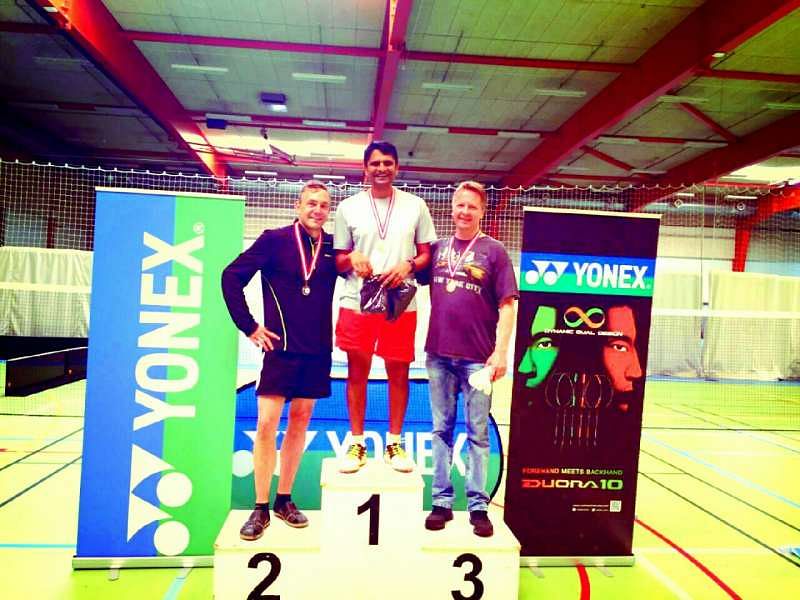
Pednekar was introduced to the sport by a fellow squash player Abhinav.
Speaking to SportsKeeda, he said:
“He gave me the interesting aspects of this sport and I got all the details through internet.I realised if I had to take part I need to have some strength in table tennis, a sport which was new to me. I gave myself six months to train hard and when I was confident I had touched reasonable level thought of my next step of participation.”
Ashutosh was already a keen squash and badminton player.
Can Ashutosh deliver on his promise of gold at the World Championships?
He replied:
“I have planned to sharpen my table tennis skills with a professional trainer and keep in good touch in the other three.”
Go well, Ashutosh, Lone Ranger of Indian Racketlon!
Anil Kumble: Surprise selection as Team India Coach

Indian cricketer Anil Kumble. (Photo credit: Wikipedia)
Anil Kumble is the newly appointed Team India coach.
That must be the most important job in the country after the Prime Minister’s, right?
Wrong, dead wrong.
Sanjay Manjrekar , in his column for The Week, describes the job thus:
“’Tell me, who is this guy with the Indian team, is he a player?’
‘No, he does not step onto the field.’
‘Is he a selector, does he pick the players?’
‘No, he does not, the captain and selectors do that.’
‘Okay, then, does he make the critical game-changing decisions on the field, with regard to bowling changes, field setting, batting order, etc?’
‘Nope, that again is done by the captain.’
There you go, that is the actual reality of an Indian coach and his position within the team. Hence the media excitement, every time, around the appointment of an Indian coach, baffles me.
In contrast, when a far more important and influential position outside the players is filled, it’s only duly noted by the media. That is the chief selector’s position.”
This is not to deride or belittle Anil Kumble’s credentials in any way.
Much has been said and written about his stellar cricketing record, his courage facing the West Indian quicks and his mental strength,
Kumble recognises the above reality and claims that he’ll be more of an ‘elder brother’ to the side.
He said:
“I certainly believe that as a coach of a young team, you need to be hands-on and you need to really get your hands dirty as well – train with them, be a part of their training. And be with them more like an elder brother, in every aspect, not just on the field, but also off it. That’s something I will be focusing on.”
Manjrekar concludes his piece thus:
“In Indian cricket, the captain and a couple of senior players basically chart the destiny of the Indian team. The selectors have an important role to play in this journey. If the captain is able, there is nothing wrong with this kind of culture; many great teams have been built like this.
So what an Indian coach really does is facilitate the needs of the captain and the core group and try and keep them in good spirits.
The coaches that actually make a difference to Indian cricket are those that coached players like Tendulkar, Dravid, and others, when they were kids. The grassroots level coaches.”
Kumble made a three-year-plan presentation to the Cricket Advisory Committee but has been appointed for only a year.
Ravi Shastri’s stint as Team Director and the results under his tutelage paved the way for the selection of an Indian coach.
Can Kumble prove as adept as John Wright or Gary Kirsten in handling this young side?
India play 13 Tests at home and his tenure includes the Champions Trophy.
‘Jumbo’ does not have a long rope and there is speculation that he was not an unanimous choice.
Kumble has no formal coaching experience but then neither had Shastri.
That appears to have made the difference since he was not in the initial shortlist.
The CAC selected Kumble—possibly—because he is a much younger candidate and can keep pace with the youngsters in the side. John Wright and Gary Kirsten were not too long retired when they took over the reins of the Indian side.
A younger person can be more hands-on; Kumble certainly believes he can be.
Is hands-on what the job requires? Depends on how you define it. Kirsten felt that it played an important role while he was coach. He used to spend hours bouncing balls at the senior players. His ability to handle fragile super-egos cannot be underestimated.
Kirsten’s right if we are go by what Manjrekar writes. And he is an expert.
Players like Virender Sehwag and Virat Kohli prefer to consult their old coaches on technical aspects of their skills.
Is it less likely that it’s not the same for the current batch of players? Ajinkya Rahane and Robin Uthappa have retained Pravin Amre as their go-to person for improving their willow skills.
It does appear that what a coach brings to the side is intangible but the results are visible and rewarded or penalised with much more alacrity.
Simply put, the coach is the fall guy should anything go wrong.
Leander Paes: Traditionalist
“I may wear an earring at times, fool around with the way my hair is styled and I love to play around with fashion. But, deep down I am a traditionalist.
—Leander Paes.
Who’s going to Rio? Mary Kom or Vijender or neither? (Updated)
Shiva Thapa is the sole Indian boxer to qualify for this year’s Olympics so far.
There could be a few more if results are favourable at AIBA’s World Qualifying tournament in Baku.
However, there are two boxers—both former Olympians, both former medallists—-who are hoping for indirect entry to Rio.
They are Mary Kom and Vijender Singh.
While Kom failed to qualify, Vijender turned professional last year. That ought to have ended his bid for yet another medal but he was provided a glimmer of hope when AIBA opened their doors to pros earlier this month.
Singh, however, has a WBO Asia Pacific title bout scheduled for July 16 in New Delhi against Kerry Hope.
That effectively belied his Olympic aspirations—or so, we believed. The professional boxers qualifying tourney is scheduled a week earlier in Venezuela.
But Vijender has other ideas.
Speaking from Manchester, the former three-time Olympian said:
“Why can’t there be a wild card entry for me? Why can’t the ad-hoc committee demand the same for me from the AIBA? They are making every effort to get a wild card for Mary Kom despite the fact that she has not qualified for Rio. But in my case, there is a clear bias because no one in India is serious about my Olympic participation.
I should also be given a chance if the rules have been relaxed by the AIBA for pro boxers to compete at Rio. I am a three-time Olympian and have fought in Commonwealth Games, Asian Games as well as World Championships.”
Vijender believes he is being discriminated against because he is now a professional pugilist.
He added:
“It seems that I am no longer competing for India. The officials believe that since I have turned pro, I shouldn’t have a chance of going to Rio. They feel they shouldn’t help me because I no longer represent India in amateur boxing. I am fighting my professional bouts under the tri-colour. My name is announced as ‘Vijender Singh from India’. All my victories in the pro circuit are for India. My Asian title bout will be for India.”
Welcome back to the merry go round of Indian sportingdom, Vijender.
And it is a merry-go-round.
Mary Kom is being forced to run from pillar to post just to ensure that the Indian Olympic Association files an application for a wild card entry with the International Olympic Commission.
Three wild card entries under the Tripartite Commission Invitation Places are up for grabs in three women’s weight categories — 51kg, 60kg and 75 kg.
These are usually used to promote sport in certain countries.
The IOC can allocate these to players of repute who fail to qualify.
But either the national federation or the national Olympic body has first to apply for a wild card entry.

Vijender singh at the sahara indian sports award (Photo credit: Wikipedia)
That, unfortunately in Kom’s case, has not yet occurred.
The DNA listed the criteria for Invitation Places as follows:
-
“National Olympic Committee (NOC) priority: based on NOC preferences, as specified in the applications submitted
-
International Federation (IF) priority; based on the assessment of the athletes’ technical level and sporting merit during the qualification period
-
International Olympic Commission (IOC) priority; based on various principles in relation to the objectives of the commission, including:
-
Universality
-
Continental balance
-
Gender equity
-
NOC and athlete eligibility
-
Technical level to compete safely and with dignity
-
Olympic scholarships for athletes”
All this while the IOA’s first choice as Goodwill Ambassador, Salman Khan, steals the limelight with his ill-timed and ill-advised remark comparing his bodily aches post the intense workouts he endured shooting for his upcoming film ‘Sultan’ to those of a ‘raped woman’.
How much better it would have been had Salman Khan spoken a few words highlighting the travails that Indian sports persons undergo merely to participate in an Olympics.
That’s what ambassadors are for, that’s what they do.
–––––—-+++±+++++++++++++++
Mary Kom’s application for a wild card entry has been rejected by AIBA. The IOC does not permit wild cards to players from nations who have eight or more representatives in a sport. India fielded eight or more boxers at the last two Games.
Vijender Singh: Sports and entertainment
“Be it the Indian Premier League, football or wrestling, people watch sports for entertainment. It is the same with pro boxing; people come to see a good fight. They don’t want to see soft counter-punches. Nobody comes to watch a nice person. They want to see brutal fights and blood.”
—Vijender Singh.
Number of readers subscribed
Read it on Apple News

Read it on Apple News
Stat Counter
 Sports, Health and Exercise
- An error has occurred; the feed is probably down. Try again later.
 Make Time For Sports.