Make Time For Sports.
Running
Rahul Verghese: Resuming training
“… if you are a regular marathoner and run two to three marathons a year evenly spaced out and take a three-month break from running, you need to resume your training on the ground floor of the training schedule. Do not try to start from where you left off, even if you have been an active cyclist or swimmer during the gap period. Each sport uses different muscles and needs a different focus.”
—Rahul Verghese.
Joe Henderson: Look back
“You also need to look back, not just at the people who are running behind you but especially at those who don’t run and never will . . . those who run but don’t race . . . those who started training for a race but didn’t carry through . . . those who got to the starting line but didn’t reach the finish line . . . those who once raced better than you but no longer run at all. You’re still here. Take pride in wherever you finish. Look at all the people you’ve outlasted.”
— Joe Henderson.
Rahul Verghese: Unlearning
”A third, and more basic, level of unlearning in order to learn is when having learnt on your own, and reached a certain stage, you then plan to take a quantum leap . Often we realize that what is required is not harder work, but a smarter way of doing the same thing.”
—Rahul Verghese.
Rahul Verghese: Basic principles
”… you may find these basic principles can be applied to your work and to managing your workload:
■ Never try and do the same thing repeatedly if you are trying to improve.
■ Look at a holistic build- up and focus on different weak links.
■ Do not work to exhaustion but work towards a build-up scientifically and sensibly, so that come the big day, you are ready to be firing on all cylinders.
■ Rest adequately.
■ And . . . you can write in your very own set of learnings.”
—Rahul Verghese.
Milind Soman: Running lights me up
“Something triggers internally the moment when my bare feet touch the earth. To put it simply, running lights me up. The light that burns within me reaches my soul when I run – it alerts my mind, and my body simply loves it. Nothing compares to the light within me when I run.”
—Milind Soman.
Mahesh Bhupathi: Run with your mind
“After a certain distance, you run with your mind, not with your legs.”
—Mahesh Bhupathi.
From Sofa to 5k: A Review
“In the morning of 3rd February, 2007, I was lying naked on a cold metal table. My entire body was being shaved, except the head. I was joking with the hospital attendant that this was a contrast to the tonsure at Tirupati, where the head was shaved and the body hair left untouched!
I was praying hard to HIM that my Coronary Artery Bypass Graft procedure (CABG aka Open Heart Bypass Surgery) should go well. So were my family members who had assembled outside.”
Thus begins the preface of P. Venkatraman’s book, “From Sofa to 5K: A Beginner’s Handbook on Running for Good Health” with a foreword by renowned cardiologist Dr. Aashish Contractor who is also an avid long distance cyclist and runner.
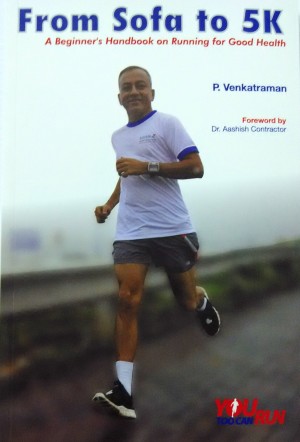
Contractor concludes his foreword as below:
“May fortitude hasten you and let temperance chasten you.”
Venkatraman outlines his story in the prologue describing his family history of heart disease beginning with his grandfather. His father and younger brother too were similarly affected.
Venkat details how he was always health and diet-conscious throughout his early life.
The author began running in 2004 and by the very next year was completing half-marathons. All this physical activity, however, could not prevent a 100% blockage of his left artery. And in Feb 2007, Venkatraman underwent heart surgery.
In January 2008, he ran the Mumbai half-marathon once more highlighting the second coming of the inspirational founder of You Too Can Run.
You Too Can Run’s mission is ‘To Promote Running For Good Health’.
Venkatraman divested his stake in one of India’s largest BPOs where he was a Promoter Director and founded his social enterprise.
The book is an attempt to inspire others to take up running for their health and is published by You Too Can Run Sports Management Private Limited who have registered themselves as a publisher with the HRD Ministry.
Chapter 5 onwards tackles the actual subject of running for beginners.
IITian and running coach Daniel Vaz is the technical editor of the book while nutritionist Kinita Kadakia is a major contributor to sections dealing with weight loss.
Venkatraman initially lists the psychological, social and physiological reasons for running.
There follows an entire chapter devoted to getting started—the most interesting part is how to handle aggressive stray dogs.
Chapter 7 deals with progressive loading and has a beginner’s 5K running plan pull-out.
Most beginners are astounded that they don’t start losing pounds immediately or sometimes for quite a while despite being quite regular and disciplined with their exercise programme. Kadakia answers these questions in the chapter ‘Running and Weight Loss‘ and how losing weight is simply about burning more calories than you consume i.e. a calorie deficit has to be created and maintained.
Finally, ‘Staying Motivated‘ is simply about that—how to keep oneself going and how it all begins with setting a goal.
The book also provides a Daily Health Log sheet that helps runners cultivate a habit of checking their progress towards their goals.
The book is of value specifically to someone who wishes to start a running regimen.
Recommended for beginners—you could do worse.
Related articles
 Physical activity boosts kids’ brain power and academic prowess(ukedchat.com)
 Making time to exercise #FridayReflections(mumbaionahigh.com)
 Women’s Fitness – Why Do You Want to Train?(merrell.com)
 Exercise Helps Children Learn, Make Better Grades In School: Experts(techtimes.com)
 Exercise ‘can help improve brain’(yorkshirepost.co.uk)
 Physical Activity Primes Children’s Brains For Academic Excellence, Finds Study(medicaldaily.com)
 Healing heart(tns.thenews.com.pk)


Bhaag, Milkha, Bhaag: Biopic for masses and classes
Rating: 3.5 stars out of 5
Language: Hindi
Directed by:
Rakeysh Omprakash Mehra
Produced by:
Rajiv Tandon
Raghav Bahl
Maitreyee Dasgupta
Madhav Roy Kapur
Rachvin Narula
Shyam P.S
Navmeet Singh
P. S. Bharathi
Written by:
Prasoon Joshi
Based on
The Race of My Life by Milkha Singh and Sonia Sanwalka
- Farhan Akhtar as Subedar Milkha Singh a.k.a. The Flying Sikh
- Japtej Singh as young Milkha
- Divya Dutta as Isri Kaur, Milkha’s elder sister
- Meesha Shafi as Perizaad
- Pavan Malhotra as Hawaldar (Constable) Gurudev Singh, Milkha’s coach during his days in the Indian Army
- Yograj Singh as Ranveer Singh, Milkha’s coach
- Art Malik as Sampooran Singh, Milkha’s father
- Prakash Raj as Veerapandian
- K.K.Raina as Mr. Wadhwa
- Rebecca Breeds as Stella
- Dalip Tahil as Jawaharlal Nehru
- Dev Gill as Abdul Khaliq
- Nawab Shah as Abdul Khaliq’s coach
- Jass Bhatia as Mahinder
- Sonam Kapoor as Biro, Milkha’s fleeting love interest
The movie begins with the Flying Sikh’s heart-breaking loss at the Rome Olympics in the 400 metres. Milkha Singh is far ahead of the field but turns to see where his rivals are losing vital seconds. The result is a fourth place finish; he too breaks the Olympic record alongside the medallists.
Milkha is haunted by ghosts of his childhood past from Govindpura, in the then Punjab Province, British India—now Muzaffargarh District, Pakistan.
Milkha’s parents, a brother and two sisters were slaughtered before his eyes in the violence that ensued following the partition of British India.
The film takes off with Milkha’s return to India and his refusal to lead a contingent of Indian athletes to Pakistan to race against Abdul Khaliq—-the fastest man in Asia.
Milkha’s back story is narrated by Pavan Malhotra as Hawaldar Gurudev Singh, Milkha’s former coach, and how he made the journey from a refugee camp to becoming the foremost Indian sportsperson of his generation and arguably of all time.
The movie is gripping while depicting life in a refugee camp and young Milkha’s initiation into a life of petty crime but meanders in scenes portraying his first love Biro.
To prove himself worthy of her, Milkha quits his criminal ways and joins the army.
The young Sardar starts running to gain an extra glass of milk, two eggs and excusal from regular drill.
Milkha is soon on his way becoming one of India’s top athletes and making the cut for the 1956 Melbourne Olympics.
There he meets and falls for Stella (played by Rebecca Breeds), the grand-daughter of his Australian technical coach. Breeds is charming and delightful lighting up the screen in her cameo.
The Games, however, are a disaster for Milkha. He loses and vows to make good by breaking the existing world record of 45.90 seconds.
He trains hard over the next four years with unyielding determination and even rejects a romantic overture from Indian Olympic swimmer Perizaad.
Milkha takes the world by storm in the run-up to the Rome Olympics and is one of the pre-Games favourites for the 400 metres.
The rest is history.
Milkha makes the journey across the border for the Friendly Games against Pakistan after being persuaded by Indian Prime Minister Jawaharlal Nehru.
The highlight of the movie is his visit back to Govindpura where he exorcises past demons and is reunited with childhood friend Sampreet.
The race against Abdul Khaliq is a formality with Singh much too strong and powerful for his opponents.
The film ends with an older Milkha Singh completing a victory lap visualizing his boyish self running alongside him.
Overall, an enjoyable movie especially for sports fans and a Don’t miss if you’re a follower of Indian athletics.
Rahul S Verghese: Running, living and marketing
The first part of the interview can be read here.

As in one of the TEDx videos’s, this is a journey of passion and that has fewer business plans but is more about like minded people connecting – whether as customers, or as partners. We constantly seek out people with passion, and that’s what drives us.
People come from across the country and from varied backgrounds and with the intermingling, apart from the fun, we all learn a little more about life, and some aspect of our planet. Birdwatchers, photographers, environmentalists, explorers, trekkers, come to life as we all step out of our work clothes – and they come from across India – from all walks of life and varied professions.The country is vast and varied and has so much to offer and we are increasingly stuck in our air-conditioned offices. Our runs are about an immersion into the environment, whether near or far from home, and falling in love with it, and in an oblique way, getting people more engaged about ecology and sustainability.
Don’t agree with you at all that Mumbai suffers in comparison. Aarey is a lovely green space with leafy paths and is accessible and provides the additional toughness and the twist in the tale. A run on a beach is a different experience, and that’s what we strive to provide – different experiences – across the country.
Which race amongst the R & L ones, in your opinion, has the toughest course?
The Aarey run in June, the Aravalli run in July, Shimla in Sept are tough, but the Rishikesh 25k is the most challenging.
A marketing company with a passion for running and where running is the fun platform to connect. Thats how we strive to make our experiences sustainable.
Nothing path breaking is easy to sell. If it is, its not path breaking 🙂
If you think of it as ‘uprooting‘ anything is tough, if you think of it as a transition of fusing 25 years of marketing experience with 7 years of running experience, it is not. Any transition has its challenges and entrepreneurship provides its thrills, tests and rewards. And I thrive on challenge and adventure.
You studied at IIM Ahmedabad from 1980 to 1982. The IIMs are facing competition from several management schools both private and foreign. What are your thoughts on this phenomenon?
I think the IIM’s are poor marketing and business organisations, and the huge governmental control does not help their case. They need to shake out and do case studies on themselves and get their students – freshers, mid managers and senior managers to ideate on different strategies and get their management teams to go out and build an exciting vision and move forward.
How would you define yourself now?
Final word for the readers-
The most critical thing about running for you is to enjoy it rather than it being a chore, or being stressed out about some aspect of it, or being too caught up with distance or speed or form etc. There is a time and place for each one of them, but the backbone has to be enjoyment. Have fun.
Rahul Verghese is the founder of Running and Living.
Disclosure: The interview was facilitated via email. Answers are published after running spell-check.
Rahul S Verghese: Family man, marathoner and musician
 Rahul Verghese is the founder of Running and Living, “a marketing company with a passion for running.” Their goal is to get 200 million Indians running: man , woman and child. Their marketing goal? Let’s talk about that later, shall we?
When did you start running? What was your first race? How many races have you completed so far? Can you break it down by distances?
I started running in December 2000 and ran my 1st Marathon in Oct 2001 in Chicago. Have done 54 Marathons and Ultra marathons across 6 Continents so far.
You’ve written and published a book, Unleash Your Potential. (I haven’t read it.) What’s it about?
My book – “Running And Living – unleash your potential” is about Running And Life and the several parallels and learnings between them. It’s about the multiplicity of impact points that running can have on you as a person and fire you up with passion, get you to start dreaming, and then going on to living your dream, whatever it may be.
Lots of lessons from Running that I incorporate into my daily life – read the book – Running And Living 🙂
Have you ever not completed a race? When and why?
I have had one DNF at a 50km trail run in Faridabad. I had not trained as required and paid the price with getting cramps and opting out at around the 40km mark. Big learning that like on Wall Street you are only as good as your last quarter.
Have you run races injured or sick? What’s your advice to runners concerning it?
I have never run a race sick, I have run a Chicago marathon post hernia surgery in 2003 and a San Francisco Marathon post a fall on my back. I took it really easy in both and kept a strict watch on listening to my body. I never take pain killers as that would mask any signals I need to listen to. I would suggest that if you are sick or injured – run a shorter distance if possible, else run much slower than planned – or change your objective to having fun – carry a camera, cheer people on – or else just opt out of the run and perhaps volunteer or spectate. There is always another run to participate in when you are back to normal.
Where do you usually train? How often?
There is no usual place that I train – the usual place that I train is – Outdoors – wherever I am. I am in the Himalaya this week and I will be running at around 12000 feet. But its not training for some event. I am just running to enjoy myself and be out in nature.
I came across a picture of you holding a guitar in one of your Facebook posts? Are you also a musician? What instruments can you play?
I like playing the Guitar and Harmonica and singing 🙂
You’re married. What’s your spouse’s name? What does she do? Any children? What are they doing?
My wife Jamuna runs on and off. She’s a banker and now consulting with PWC. My daughter Diya is working with VISA and my daughter Naina is studying economics and psychology, with a year more of college to go.
If you were to do it all over again, what would you change? Why?
I wouldn’t change anything if I was to live life over again. I have enjoyed every moment so far and will continue to do so.
Part II of this interview will follow when Rahul Verghese returns from the Himalayas on May 10.
Disclosure: The interview was conducted via email. Answers are published as-is except for spell-check.
Number of readers subscribed
Read it on Apple News

Read it on Apple News
Stat Counter
 Sports, Health and Exercise
- An error has occurred; the feed is probably down. Try again later.
 Make Time For Sports.